Get dairy management tips weekly
Join 200+ dairy farmers getting practical KPIs, breeding insights, and profitability tips — no spam, unsubscribe anytime.
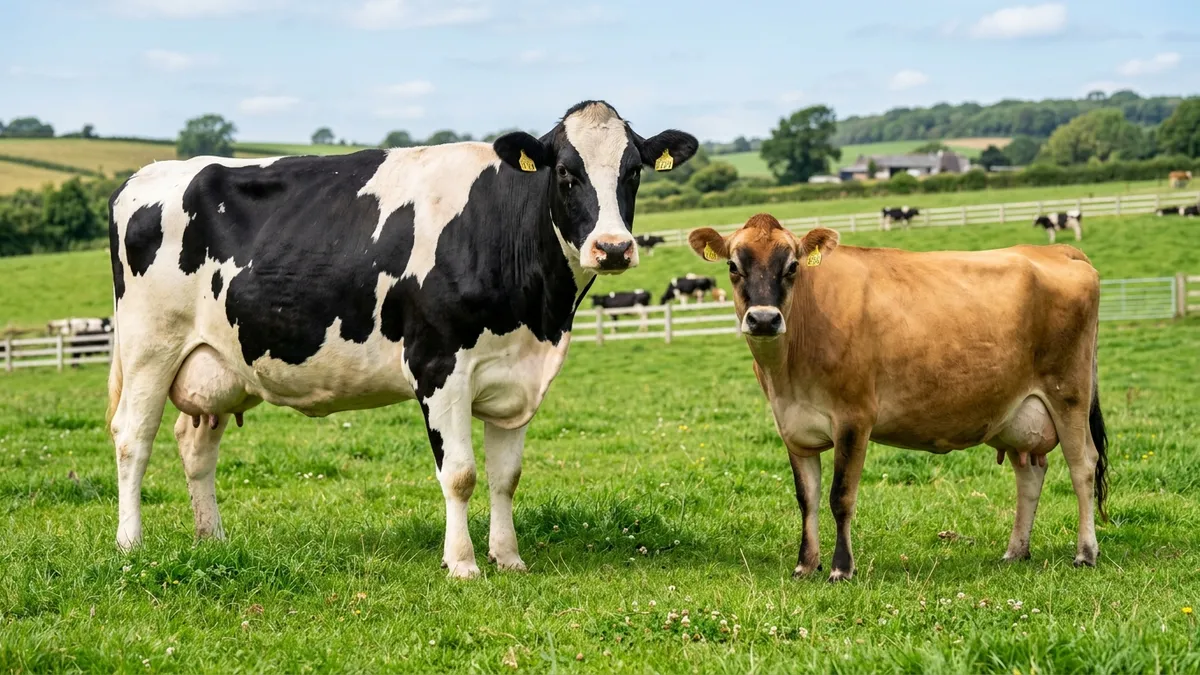
The classic dairy debate: Volume vs. Components. If you are starting a dairy farm or looking to shift your herd dynamics, choosing between the Holstein Friesian and the Jersey is the most critical genetic decision you will make. This guide compares their milk yield, feed efficiency, health traits, and ultimate profitability.
Quick Answer: Holstein vs Jersey
Choose the Holstein if you are paid on fluid volume and have cheap, abundant forage — she produces 30–40 L/day at 3.7% fat. Choose the Jersey if you are paid on butterfat/protein components, farm in a hot climate, or graze — she produces 18–25 L/day at 5.0–5.5% fat, needs ~30% less feed, and lasts 4–5 lactations vs. the Holstein's 2.5–3. Most component-priced and pasture operations turn a higher margin per cow with Jerseys.
At a Glance: Head-to-Head Comparison
The table below summarizes the key differences before we dive into each factor. Use it as a quick reference for your breeding decision.
| Metric | Holstein | Jersey |
|---|---|---|
| Mature Body Weight | 650–750 kg | 400–500 kg |
| Daily Milk Yield | 30–40 L/day | 18–25 L/day |
| Butterfat | 3.6–3.8% | 5.0–5.5% |
| Protein | 3.0–3.2% | 3.7–4.0% |
| Daily DMI | 24–28 kg | 18–20 kg |
| Productive Life | 2.5–3 lactations | 4–5 lactations |
| Heat Tolerance | Poor (heat-stress sensitive) | Good |
Milk Yield & Composition: Volume vs Components
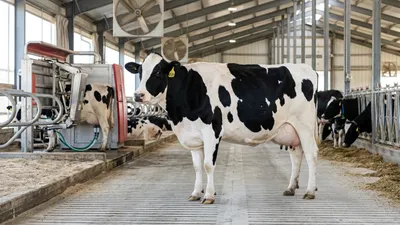
When it comes to pure fluid milk output, the Holstein cow is the undisputed king. A well-managed Holstein herd can easily average 30 to 40 litres per day, with top cows peaking above 50 litres. However, Holstein milk is relatively "thin," typically containing 3.7% butterfat and 3.1% protein.
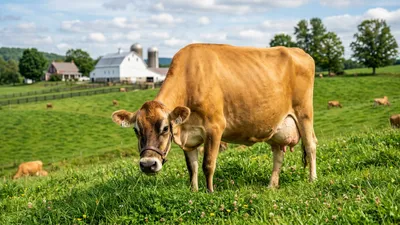
The Jersey cow takes the opposite approach. She produces significantly less fluid volume—averaging 18 to 25 litres per day—but her milk is incredibly dense. Jersey milk averages a premium 5.0% to 5.5% butterfat and 3.7% to 4.0% protein.
Components & Manufacturing Value: The Cheese Yield Advantage
Fluid volume is only one way to value milk. Most of the world's milk is ultimately manufactured into cheese, butter, and powder — and there, component density decides the cheque. Because Jersey milk carries more fat, protein, and specifically casein per litre, it converts far more efficiently into solid dairy products.
This is not marketing folklore; it is measured in the vat. A 2019 study published in the Korean Journal for Food Science of Animal Resources (Yoo et al.) comparing cheese yield from the two breeds found that Jersey milk yields 12.0–12.8% cheese versus 9.5–10.7% for Holstein milk on a weight basis. Cheesemakers commonly report needing roughly 20–25% less Jersey milk to produce the same pound of cheese, and buttermakers see butter-yield gains of over 30%.
| Manufacturing Metric | Holstein | Jersey |
|---|---|---|
| Cheese yield (Yoo 2019) | 9.5–10.7% | 12.0–12.8% |
| Casein as % of protein | Lower (least of major breeds) | Highest of major breeds |
| Milk to make 1 lb cheese | Baseline (~10 lbs) | ~20–25% less |
| Butter yield gain | Baseline | +30% or more |
Why Casein Is the Real Driver
Casein is the protein that forms the cheese curd. Studies of breed composition (including USDA mozzarella-yield work) consistently find the highest casein percentage in Jersey and Ayrshire milk and the lowest in Holstein and Guernsey. Since cheese yield depends directly on casein content, Jersey and Ayrshire milk is inherently better suited to cheesemaking — the higher butterfat simply adds to the advantage.
Who this matters for: if your milk is priced on component values, sold to a cheese or butter plant, or marketed direct as "rich" milk, the Jersey's density is a direct revenue advantage. If your buyer pays a flat rate per litre of fluid milk regardless of solids, that advantage is not captured at the farm gate — which is exactly why fluid-priced markets favour the Holstein.
Feed Efficiency (FCE) and Dry Matter Intake
A mature Holstein weighs 650–750 kg and requires massive amounts of feed simply to maintain her body weight before she even begins producing milk. Expect a Holstein to consume 24–28 kg of Dry Matter Intake (DMI) daily.
Jerseys are much smaller (400–500 kg) and require only 18–20 kg of DMI. When you calculate Energy Corrected Milk (ECM)—which adjusts milk volume based on fat and protein energy—Jerseys consistently show superior Feed Conversion Efficiency (FCE). They produce more nutrient-dense milk per pound of feed consumed than Holsteins. For the exact DMI requirements behind these numbers, see the Holstein milk production guide.
| Feed Efficiency Metric | Holstein | Jersey |
|---|---|---|
| ECM per lb of DMI | 1.67 | 1.75 |
| Feed cost per lb of fat | ~$1.97 | ~$1.82 |
| Daily DMI (mature cow) | 24–28 kg | 18–20 kg |
Jerseys convert roughly 5% more feed into energy-corrected milk and produce fat at a lower feed cost. This efficiency gap widens further when feed prices rise, which is why Jerseys gain ground in high-feed-cost environments.
Health, Heat Tolerance & Longevity
In commercial settings, Jerseys typically outlive Holsteins. The average productive life of a Holstein is 2.5 to 3 lactations, whereas Jerseys frequently remain profitable for 4 to 5 lactations. This is not a marginal difference — it directly lowers your annual replacement rate and the cost of raising or buying heifers.
A review by The Ohio State University's Dairy Industry Resources Center summarised the breed differences in plain terms: compared with Holsteins, Jersey cows have earlier first calving, easier calving, reduced mastitis, reduced lameness, and greater longevity, while their smaller size and temperament make them easier to handle on both pasture and concrete. This pattern holds across climates, which is why the same review notes the industry has "rapidly increased Jersey and Jersey × Holstein crossbreed numbers."
| Health / Longevity Trait | Holstein | Jersey |
|---|---|---|
| Productive life | 2.5–3 lactations | 4–5 lactations |
| Calving ease (dystocia) | Moderate–higher risk | Easier (smaller calf) |
| Mastitis incidence | Higher | Lower |
| Lameness | Higher (heavier on concrete) | Lower |
| Heat tolerance | Poor (heat-stress sensitive) | Good |
- Heat Tolerance: Jerseys are significantly more heat-tolerant. Holsteins begin suffering from heat stress at a lower THI index, resulting in sharp milk drops during summer.
- Calving Ease: Jerseys have a wider pelvic structure relative to their calf size, resulting in near-zero calving difficulties.
- Hoof Health: Because they are lighter, Jerseys suffer from fewer lameness issues on concrete floors.
- Metabolic Diseases: Holsteins, due to their extreme milk volume, are more prone to metabolic disorders like milk fever, ketosis, and displaced abomasums — especially in the transition period covered in our milk production guide.
Profitability Analysis: Which is Better?
The answer depends entirely on how you get paid and your feed costs. Use our Milk Yield Calculator and Dairy Profit Calculator to run the exact numbers for your farm, but follow these general rules:
- Choose Holsteins if: You are paid on a strict fluid volume basis (per litre/gallon) with little to no premium for butterfat, and you have access to cheap, abundant forage.
- Choose Jerseys if: Your cooperative pays a high premium for fat and protein (component pricing), you operate in a hot climate, or you are pasture-grazing where smaller cows cause less field damage.
What the Research Says: The $456 Question
Large-scale economic studies have attempted to settle this debate with real herd data. A 2023 analysis published in the Journal of Dairy Science Communications (Olthof et al., building on earlier work by Bailey et al., 2005) found that Holstein cows are on average about $456 more profitable per cow per year than Jersey cows under typical US component-pricing economics. About 77–78% of that revenue advantage comes from higher milk and component output (Holsteins produce roughly 880–810 more lbs of components per year), which also spreads fixed costs (facilities, labor, equipment) across more saleable product.
| Economic Factor | Holstein | Jersey |
|---|---|---|
| Annual profit per cow (research avg) | ~$456 higher | Baseline |
| Source of advantage | 78% from components + volume; spreads fixed costs | Lower feed & maintenance cost per cow |
| IOFC per 100 cows (Bailey 2005) | +$31,221/yr vs Jersey | Baseline |
| Fixed-cost efficiency | More milk per stall / per labor unit | More cows per stall; lower feed cost/lb fat |
Important context: this $456 figure reflects an average across conventional large-scale US operations with abundant feed and component pricing. The gap narrows or reverses when: (1) feed is expensive or scarce, (2) you are pasture-based, (3) you sell direct-to-consumer at a Jersey-milk premium, or (4) heat stress penalizes Holstein output. Jerseys close the gap by improving their per-cow yield and leveraging their feed-efficiency edge. The right answer is farm-specific — model your own numbers rather than relying on the national average.
Which Breed Should You Choose? A Decision Framework
Instead of picking a "winner," match the breed to your operation. Answer three questions and the choice usually makes itself:
| Your Situation | Better Fit | Why |
|---|---|---|
| Paid per litre of fluid milk, flat pricing | Holstein | Max volume wins when solids aren't rewarded. |
| Sold to a cheese/butter plant, component pricing | Jersey | Higher casein & fat = more product per litre. |
| Pasture-based / grazing operation | Jersey | Better FCE, less treading damage, hardier. |
| Hot climate with poor cooling infrastructure | Jersey | Heat tolerance protects summer yield. |
| Low feed cost, abundant forage, large scale | Holstein | Spreads fixed costs over more saleable milk. |
| Small land base, high feed cost, premium retail | Jersey | More solids per acre, richer milk consumers pay for. |
The Third Option: The Holstein × Jersey Cross
You do not have to choose. A growing share of the world's dairy herd is now a Holstein-Jersey cross — known as the HoJo in the US or the Kiwi Cross in New Zealand and Australia. The Ohio State review notes the industry has "rapidly increased Jersey and Jersey × Holstein crossbreed numbers," and the reason is hybrid vigour (heterosis).
The cross aims to keep the Holstein's volume while importing the Jersey's components, fertility, calving ease, and longevity. In practice, a first-generation (F1) Holstein-Jersey cow typically yields slightly less fluid than a pure Holstein but with noticeably higher fat and protein, and she stays in the herd longer — often lifting lifetime profit even when per-lactation volume dips. The trade-off is herd complexity: crossbreds are harder to keep uniform, and buyers who want a single consistent breed (or purebred-breeding replacements) may discount them.
If crossbreeding interests you, our crossbred vs purebred guide covers structured systems like ProCROSS and the long-term profit data, and the breeding and reproduction guide explains how to implement them.
Whichever breed you choose, the next step is unlocking the production potential of the herd you build. Our guide to increasing milk production covers the seven management levers — DMI, transition period, milking frequency, heat stress, SCC, dry period, and genetics — that apply equally to both breeds. If you are still deciding on genetics, our best dairy cow breeds guide compares the wider field, and crossbred vs purebred explains why a Holstein-Jersey cross often beats both.
Track your herd’s performance in one place
Log milk yield, monitor breeding, track expenses, and generate reports — all from your browser. No download needed.
Frequently Asked Questions
Do Jerseys eat less than Holsteins?
Yes. An average mature Jersey cow weighs around 450 kg and consumes about 18-20 kg of dry matter (DMI) per day. A mature Holstein weighs around 700 kg and consumes 25-28 kg of DMI per day. Jerseys are highly efficient at converting smaller amounts of feed into milk solids.
Which cow's milk tastes better, Holstein or Jersey?
Many consumers prefer Jersey milk because it contains approximately 28% more butterfat and 20% more protein per glass than Holstein milk, along with significantly more calcium. The higher fat content gives it a richer, creamier taste and a slightly yellowish tint due to higher beta-carotene levels.
Which cow is more profitable, Holstein or Jersey?
Profitability depends on your milk market. If your dairy cooperative pays primarily for fluid volume, Holsteins are usually more profitable. If you are paid a premium for butterfat and protein (cheese yield), or if feed costs are exceptionally high, Jerseys often yield a higher profit margin per acre.
Are Jerseys easier to calve than Holsteins?
Yes, Jerseys are renowned for their calving ease. They have less dystocia (calving difficulty) compared to Holsteins, making them excellent choices for crossbreeding programs and reducing veterinary costs associated with difficult births.
Can you cross a Holstein and a Jersey?
Yes, crossing a Holstein and a Jersey produces what is commonly called a 'Kiwi Cross' or 'HoJo'. This crossbreed benefits from hybrid vigor, combining the high milk volume of the Holstein with the rich components, fertility, and calving ease of the Jersey.