Dive deep into the production metrics, feed efficiency, cheese yields, and profitability of the modern Jersey cow. Backed by the latest AJCA (American Jersey Cattle Association) records spanning 2023–2025.
Quick Answer: Jersey Cow Milk Production
A Jersey cow produces 18–25 litres of milk per day (elite herds exceed 30 L/day), with an AJCA mature-equivalent lactation yield of 20,711 lbs (~9,400 kg). Jersey milk averages 5.11% butterfat and 3.80% protein — the highest of any commercial dairy breed — yielding about 25% more cheese per hundredweight than Holstein milk. Jerseys need ~30% less feed, tolerate heat better, and stay profitable for 4–5 lactations.
Get dairy management tips weekly
Join 200+ dairy farmers getting practical KPIs, breeding insights, and profitability tips — no spam, unsubscribe anytime.
Introduction (Jersey: The Efficiency Champion)
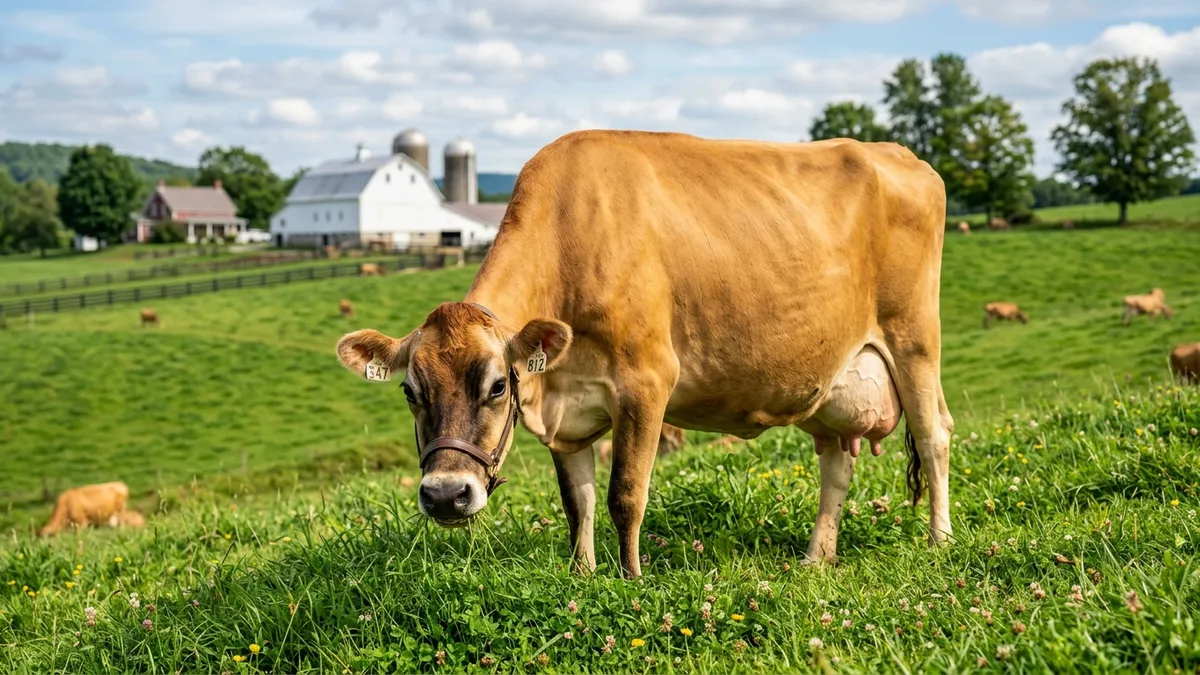
When it comes to modern dairy farming, the landscape has shifted remarkably over the past decade. No longer is volume the sole metric of success. Today, components, efficiency, and sustainability dictate profitability. Enter the Jersey cow—often hailed as the undisputed efficiency champion of the dairy world. With her fawn-colored coat and comparatively diminutive stature, the Jersey packs an economic punch that commands global attention.
The Jersey breed has undergone a remarkable transformation through focused genetic selection and advanced nutritional management. Known historically as the "family cow" providing rich milk for household butter, the contemporary Jersey is a commercial powerhouse. Why? Because the modern milk market rewards butterfat and protein—two areas where the Jersey consistently dominates. Furthermore, the environmental and economic pressures of the 2020s demand more milk output for every unit of feed input. The Jersey's smaller body mass translates to lower maintenance energy requirements, allowing a larger proportion of her feed to be converted directly into high-value milk.
This comprehensive guide explores the definitive statistics behind Jersey cow milk production, leveraging the most recent data from the American Jersey Cattle Association (AJCA) spanning 2023 to 2025. We will dissect her production records, unrivaled cheese yields, feed efficiency, milk composition, heat tolerance, and how she stands head-to-head against the Holstein. Whether you are considering diversifying your herd or optimizing your current Jersey operations, these insights will equip you with the knowledge to maximize profitability.
Official AJCA Production Records 2023–2025
To truly understand the capabilities of the Jersey breed, one must look at the hard data. The American Jersey Cattle Association (AJCA) meticulously tracks production metrics on a mature equivalent (m.e.) basis, standardizing records to account for age and season of calving. The steady upward trajectory in components over the last three years underscores the immense genetic progress achieved by Jersey breeders.
The following table highlights the 3-year trend from 2023 to 2025, revealing a consistent dedication to enhancing fat and protein output while maintaining impressive fluid milk volumes for a smaller breed. In 2025, the average m.e. yield stands at an astounding 20,711 lbs of milk per lactation, accompanied by staggering component percentages. For context, 20,711 lbs is roughly 9,400 kg per lactation on a mature-equivalent basis — about 31 kg (≈30 litres) per day across 305 days. Actual daily yields on commercial farms typically run 18–25 litres, with elite herds routinely exceeding 30 litres per day.
| Year | Milk (lbs) | Fat (lbs) | Fat (%) | Protein (lbs) | Protein (%) |
|---|---|---|---|---|---|
| 2025 | 20,711 | 1,059 | 5.11% | 788 | 3.80% |
| 2024 | 20,719 | 1,053 | 5.08% | 781 | 3.77% |
| 2023 | 20,710 | 1,038 | 5.01% | 778 | 3.76% |
A deeper analysis of this data reveals that while milk volume has remained stable around the 20,710 lbs mark, the pounds of fat and protein have surged. The butterfat percentage climbed from 5.01% in 2023 to 5.11% in 2025. Similarly, protein rose from 3.76% to 3.80%. In an industry where milk checks are heavily driven by component pricing, this targeted increase in solid concentration directly bolsters farm revenue. The Jersey's ability to maintain fluid volume while concentrating these valuable solids is a testament to the breed's unique metabolic efficiency.
Cheese Yield: Jersey's Secret Superpower
When discussing Jersey milk, one cannot overlook its unparalleled suitability for cheese manufacturing. Cheese yield is mathematically dictated by the concentrations of fat and casein (the primary protein in milk). Because Jersey milk contains substantially higher levels of both compared to other breeds, it is the darling of artisan cheesemakers and large-scale dairy processors alike.
Based on the 2025 AJCA data, the average Jersey cow produces enough components to yield 2,694 lbs of cheese per lactation (m.e. basis). More impressively, the cheese yield per hundredweight (cwt) of milk is an astonishing 13.01 lbs. To put this into perspective, typical Holstein milk might yield between 9.5 and 10.5 lbs of cheese per cwt. This means Jersey milk can yield up to 25% more cheddar cheese per hundredweight than Holstein milk.
This "secret superpower" translates to immense logistical and economic benefits for processors. Higher cheese yields per cwt mean less water to haul, less whey to process or dispose of, and greater product output per hour of vat time. Consequently, many milk buyers offer lucrative premiums for high-component Jersey milk. For the dairy producer, capitalizing on these cheese yield premiums can significantly elevate the overall milk price, providing a crucial buffer against volatile commodity markets.
Furthermore, the structure of Jersey milk itself enhances the cheese-making process. The casein micelles in Jersey milk tend to be larger, and the milk coagulates faster and firmer, leading to less fat lost in the whey. The distinct yellow hue of Jersey milk, derived from a higher concentration of beta-carotene, also imparts a highly desirable rich color to the final cheese product, often eliminating the need for artificial colorants in traditional cheddar production.
Feed Efficiency: Why Jerseys Profit on Less
In an era of rising feed costs and heightened focus on agricultural sustainability, feed efficiency is a critical determinant of farm profitability. The Jersey cow shines brilliantly in this arena, fundamentally due to her size and metabolism. An average mature Jersey cow weighs between 900 and 1,000 lbs, considerably less than a mature Holstein weighing 1,400 to 1,500 lbs.
This smaller body mass means the Jersey has a significantly lower maintenance energy requirement. Maintenance energy is the baseline caloric intake required just to keep the animal alive, functioning, and healthy—before any energy is diverted toward milk production. Because a Jersey expends less feed on bodily maintenance, a larger percentage of her Dry Matter Intake (DMI) is partitioned directly into producing milk and components.
A standard metric used to measure this is the ratio of Energy Corrected Milk to Dry Matter Intake (ECM/DMI). Energy Corrected Milk standardizes milk volume based on its fat and protein content, providing a true measure of the energy output in the milk. For Jersey herds, the feed efficiency ratio typically ranges from 1.3 to 1.8 lbs of ECM per pound of DMI, depending heavily on the quality of forage, ration formulation, and overall management.
| Biological / Economic Factor | Mature Jersey Cow | Mature Holstein Cow |
|---|---|---|
| Mature Body Weight | 1,000 lbs (454 kg) | 1,500 lbs (680 kg) |
| Daily Maintenance Energy (NEl) | ~7.4 Mcal/day | ~10.1 Mcal/day |
| Daily Dry Matter Intake (DMI) | 38 – 42 lbs (17 – 19 kg) | 52 – 58 lbs (24 – 26 kg) |
| ECM Produced per Cow/Day | 68 lbs (30.8 kg) | 78 lbs (35.4 kg) |
| Feed Efficiency (ECM / DMI) | 1.70 – 1.79 | 1.45 – 1.55 |
| Feed Cost per Cow/Day (@ $0.15/lb DM) | $6.00 | $8.25 |
Notice the striking difference in maintenance requirements: the Holstein cow requires over 35% more energy every single day just to maintain body mass before a single drop of milk is synthesized. Over a 305-day lactation across a 100-cow herd, that maintenance differential amounts to tens of thousands of dollars in feed expense that produces zero saleable milk solids.
When feed costs surge, this efficiency translates into immediate financial relief. Jerseys essentially produce more valuable product per acre of land and per ton of feed harvested. Moreover, this efficiency aligns perfectly with environmental sustainability goals; producing more milk solids with fewer inputs results in a lower carbon footprint and reduced manure output per pound of cheese yielded.
Milk Composition: Fat, Protein & ECM Breakdown
To fully grasp the value of Jersey milk, we must break down its composition and the concept of Energy Corrected Milk (ECM). As established by the 2025 data, Jersey milk averages 5.11% fat and 3.80% protein. These are not just numbers; they represent densely packed nutrition.
Beyond gross percentages, Jersey milk's high solids content changes how it behaves in both the tank and the human digestive system. Its denser nutrient load — more fat and casein per litre — means a smaller glass delivers more energy and more protein, which many consumers find more satisfying and easier to digest than the higher-volume, lower-solids profile of standard milk.
The true measure of a cow's production effort is ECM. Because producing fat and protein requires significantly more metabolic energy than producing water and lactose, raw milk volume can be a misleading metric. In 2025, the average actual ECM for Jerseys reached 23,868 lbs (which normalizes to a staggering 26,386 lbs on a mature equivalent basis). This means that while a Jersey might produce 20,711 lbs of raw liquid, the energy contained within that liquid is equivalent to over 26,000 lbs of standard 3.5% fat milk. When farms are paid for components, the ECM is the true indicator of gross income potential.
Heat Tolerance & Management Advantages
Climate change and warming global temperatures pose a significant threat to dairy production, as heat stress dramatically depresses feed intake, milk yield, and reproductive performance. Here, the Jersey breed possesses a distinctive biological advantage: superior heat tolerance.
Several factors contribute to the Jersey's ability to handle high temperatures better than Holsteins. First, their smaller body size provides a greater surface area-to-mass ratio, allowing for more efficient heat dissipation. Second, their lighter-colored, finer coat reflects more solar radiation. Third, their lower total dry matter intake generates less internal metabolic heat during digestion.
In practical terms, during the sweltering summer months, Jersey herds consistently experience smaller drops in milk production and component levels compared to heavier breeds. They also exhibit better conception rates during periods of heat stress. For dairy farmers in the southern United States, Australia, South America, and other warm climates, this trait is indispensable.
Beyond heat tolerance, the Jersey's smaller frame offers other management advantages. They require smaller freestall dimensions, produce less manure volume, and generally exert less wear and tear on pasture and facility infrastructure. Their lighter weight also reduces the incidence of severe lameness and hoof issues, leading to improved longevity and lower veterinary costs.
Jersey vs Holstein: Which is More Profitable?
The eternal debate in the dairy industry: Jersey or Holstein? The answer is rarely absolute and depends entirely on the farm's milk market, facilities, land base, and management philosophy. However, a head-to-head comparison clarifies where each breed excels.
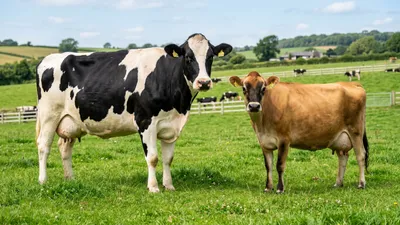
Holsteins are the undisputed kings of volume, capable of producing massive amounts of fluid milk. If a farm is located in a market that pays primarily for fluid volume with minimal component premiums, the Holstein remains difficult to beat. However, in modern pricing structures where fat and protein drive the milk check, the Jersey's economic model shines.
| Trait | Jersey Cow | Holstein Cow |
|---|---|---|
| Mature Weight | 900 - 1,000 lbs | 1,400 - 1,500 lbs |
| Average Milk Volume (lbs) | ~20,700 lbs | ~28,000 lbs |
| Butterfat % | 5.11% | 3.80% - 4.00% |
| Protein % | 3.80% | 3.10% - 3.20% |
| Cheese Yield per cwt | 13.01 lbs | 9.5 - 10.5 lbs |
| Heat Tolerance | Excellent | Moderate to Poor |
| Maintenance Energy Req. | Low | High |
When calculating profitability, one must look at Income Over Feed Cost (IOFC). While a Holstein will generate higher gross revenue due to volume, she will also consume significantly more feed. The Jersey, consuming less feed and producing higher-value milk per pound, often achieves a highly competitive or superior IOFC margin, particularly when feed prices are elevated.
Additionally, the capitalization costs for a Jersey herd can be lower. You can comfortably house more Jerseys in the same barn footprint than Holsteins. The lower volume of milk produced means fewer trips for the milk hauler and less wear on milking equipment per pound of solids harvested. Ultimately, the Jersey offers a robust, resilient business model uniquely suited to the economic and environmental realities of 21st-century dairy farming.
For the full head-to-head breakdown, read our Holstein vs Jersey comparison. To put these genetics to work, see how to increase milk production across your whole herd, and compare the Jersey against the wider field in our best dairy cow breeds guide.
Frequently Asked Questions
How much milk does a Jersey cow produce per day?
On average, a Jersey cow produces between 18 and 25 litres of milk per day, though elite herds can achieve 30+ litres daily with optimal management and nutrition.
What is the average butterfat percentage in Jersey milk?
Jersey milk is renowned for its high fat content, averaging around 5.11% butterfat according to 2025 AJCA data, which is significantly higher than most other dairy breeds.
Why is Jersey milk better for cheese making?
Jersey milk yields up to 25% more cheddar cheese per hundredweight compared to Holstein milk due to its exceptionally high protein (3.80%) and fat (5.11%) content, resulting in approximately 13.01 lbs of cheese per cwt.
Are Jersey cows more feed efficient than Holsteins?
Yes, Jerseys are often more feed efficient due to their smaller body mass, which means a lower maintenance energy requirement. Their Energy Corrected Milk to Dry Matter Intake (ECM/DMI) ratio typically ranges from 1.3 to 1.8.
How well do Jersey cows tolerate heat stress?
Jerseys handle heat stress notably better than Holsteins. Their lighter coat, smaller body size, and greater surface area-to-mass ratio allow them to dissipate heat more effectively, maintaining production during hotter months.
What is the annual milk yield for a Jersey cow?
The average mature equivalent (m.e.) yield for a Jersey cow in the latest AJCA data is 20,711 lbs of milk per lactation — roughly 9,400 kg, or about 31 kg (≈30 litres) per day across a 305-day lactation on an m.e. basis. Actual daily yields on commercial farms typically run 18–25 litres, with elite herds exceeding 30.
How does the Energy Corrected Milk (ECM) for Jerseys compare?
In 2025, the average ECM for Jerseys is 23,868 lbs (actual) or 26,386 lbs on a mature equivalent basis, reflecting the high energy density of their fat and protein-rich milk.