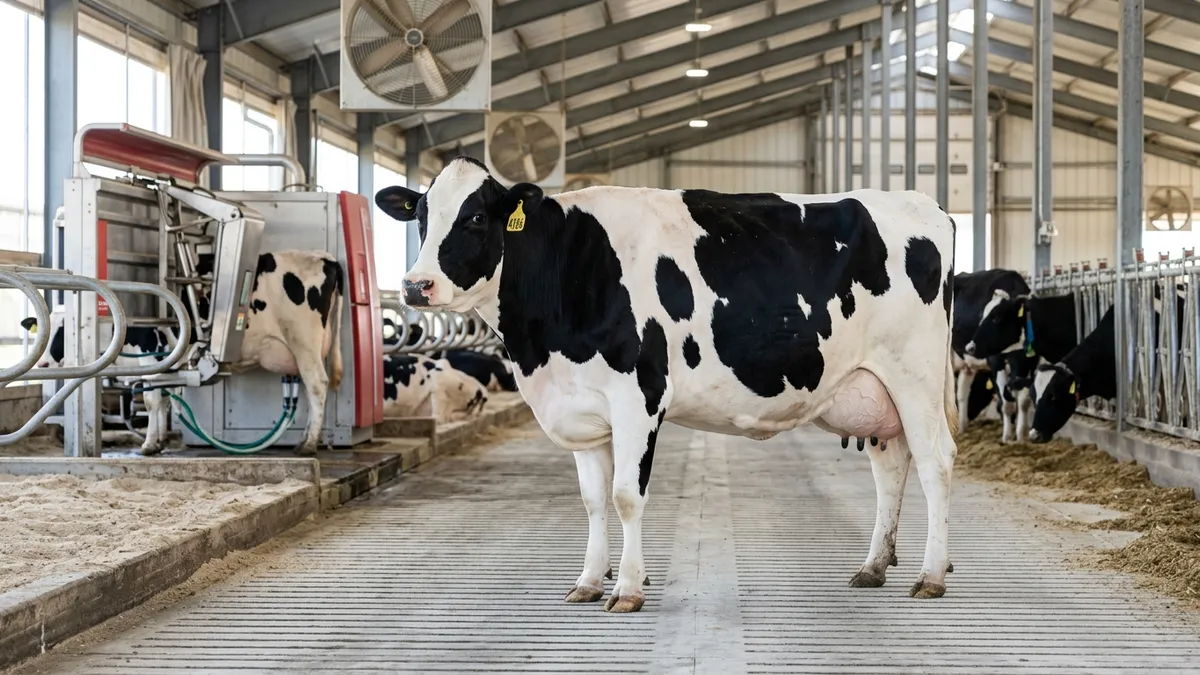
The Holstein-Friesian is the undisputed king of dairy volume. Making up about 94% of the US dairy herd (over 9 million cows) and dominating commercial operations globally, this breed has been genetically fine-tuned over decades to convert feed into massive quantities of fluid milk. This guide breaks down exact daily yield benchmarks, 305-day lactation totals, feed intake requirements, nutrient tables, and the genomic data behind the modern Holstein.
Quick Answer: How Much Milk Does a Holstein Produce Per Day?
A Holstein cow produces an average of 75 lbs (34 kg / about 9 gallons / 34 litres) of milk per day during her standard lactation, according to the Holstein Association USA. Well-managed commercial cows typically range from 60 to 85 lbs (27 to 38 litres) per day, and elite cows at peak lactation exceed 100 lbs (45 litres) per day. Across a full 305-day lactation, the average Holstein produces roughly 23,000 lbs (10,400 kg / 2,674 gallons).
Get dairy management tips weekly
Join 200+ dairy farmers getting practical KPIs, breeding insights, and profitability tips — no spam, unsubscribe anytime.
Holstein Milk Production Benchmarks (lbs & Litres)
When measuring Holstein production, you must account for the difference between a cow at peak lactation and the herd's rolling average. A cow's yield also varies by parity (number of calvings), with production typically peaking in her 3rd or 4th lactation. The table below converts the key USDA and Holstein Association benchmarks into both pounds and litres.
| Benchmark | Pounds (lbs) | Kilograms | Litres |
|---|---|---|---|
| USDA National Average (all US herds) | 60–65 lbs/day | 27–30 kg | 27–30 L |
| Breed Average (Holstein Association) | 75 lbs/day | 34 kg | 34 L |
| Well-Managed Commercial Herd | 70–85 lbs/day | 32–38 kg | 32–38 L |
| Peak Daily Yield (60–90 DIM, mature cow) | 90–110+ lbs/day | 41–50+ kg | 41–50+ L |
| 305-Day Lactation Total | ~23,000 lbs | ~10,400 kg | ~10,400 L |
Compare your herd's performance against these benchmarks using our Milk Yield Calculator.
The Holstein Lactation Curve
A Holstein's milk output is not flat — it follows a predictable lactation curve that managers must understand to balance rations correctly. Understanding this curve is critical because a Holstein's nutrient needs change drastically from week to week in early lactation.
- Calving to Peak (0–60 Days in Milk): Milk yield rises rapidly. A high-producing Holstein reaches peak yield around 60 to 90 DIM. Crucially, her dry matter intake lags behind milk yield, pushing her into Negative Energy Balance (NEB). She mobilizes body fat to fill the gap, which is normal — but excessive NEB leads to ketosis and lost production.
- Peak to Mid-Lactation (60–200 DIM): Yield slowly declines while feed intake catches up and peaks. This is the most profitable window of the lactation, and maintaining persistency (slowing the rate of decline) is a primary goal of nutrition and genetics.
- Late Lactation (200–305 DIM): Yield drops steadily. Rations are diluted of energy as requirements fall, preparing the cow for dry-off.
For a deeper breakdown of the four phases, persistency, and parity effects, read our dairy lactation curve guide.
Dry Matter Intake (DMI) Requirements
The biological rule of dairy farming is simple: milk is made from feed. Because the Holstein produces such extreme volumes of milk, her nutritional demands are immense. Feed intake is measured in Dry Matter (DM) to account for the varying moisture levels in different forages.
Feed to Milk Conversion
A high-producing Holstein generally consumes 3.5% to 4.2% of her body weight in dry matter daily. For a standard 650–700 kg (1,430–1,540 lb) cow producing 35 litres of milk, this requires 24 to 28 kg of Dry Matter Intake (DMI) per day. Penn State Extension benchmarks a bulk tank average of 75 lbs on 2× milking and 85 lbs on 3× milking as achievable targets. Failure to provide enough energy-dense feed during early lactation results in rapid body condition loss (ketosis) and a collapsed lactation curve.
To ensure this massive feed intake remains profitable, constantly track your margins with our Income Over Feed Cost (IOFC) Calculator.
Nutrient Requirements by Milk Production Level
A Holstein's nutrient requirements scale directly with her milk yield. The following table outlines approximate daily requirements for a mature 650 kg Holstein at different production levels, giving you a framework for balancing rations by group.
| Daily Milk Yield | Approx. DMI | Crude Protein | Key Management Note |
|---|---|---|---|
| 20 kg (44 lbs) | 18–20 kg (3.0% BW) | ~15% | Mid-to-late lactation group; lower energy density. |
| 35 kg (77 lbs) | 23–25 kg (3.6% BW) | ~16.5% | Standard high-producing TMR group. |
| 45 kg (99 lbs) | 26–28 kg (4.0% BW) | ~17.5% | Peak-lactation group; requires highly digestible fiber and bypass fat. |
| 55 kg (121 lbs) | 28–30 kg (4.3% BW) | ~18% | Elite producers; physical rumen fill becomes the limiting factor. |
Two practical rules follow from this table. First, physical fill limits intake: late-harvested, highly lignified forages fill the rumen and trigger stretch receptors that stop the cow from eating, even when her energy needs are unmet. High-digestibility forages pass through faster and allow higher DMI. Second, water is the silent partner of DMI: milk is roughly 87% water, and a high-producing Holstein needs 50 to 80 litres (13 to 21 gallons) of fresh, clean water daily. Dirty troughs or inadequate trough space immediately depress DMI and milk yield.
Components: Fat & Protein
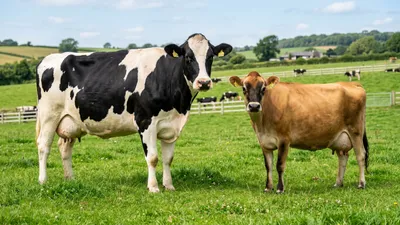
While Holsteins dominate in fluid volume, they produce more dilute milk compared to breeds like the Jersey or Brown Swiss. If your milk processor pays heavily for components (fat and protein) rather than pure volume, Holsteins may require specific ration balancing to maintain profitability.
| Component | Typical Holstein Range | Jersey Average (For Comparison) |
|---|---|---|
| Butterfat | 3.6% – 3.8% | 4.8% – 5.5% |
| Protein | 3.0% – 3.2% | 3.6% – 4.0% |
| Total Volume | 10,000 – 12,000+ L | 6,000 – 8,000 L |
Despite the lower percentages, the Holstein's volume advantage means she still produces more total fat and protein per year than a Jersey. At 3.7% fat and 35,000 lbs of milk, a Holstein yields roughly 1,295 lbs of fat; a Jersey at 5.0% fat and 18,000 lbs yields 900 lbs. This is why component-percentage comparisons alone can be misleading when evaluating breed profitability. For a head-to-head breakdown, see our Holstein vs Jersey comparison.
Genomics & Genetic Trends
The modern Holstein is a product of one of the most successful genetic improvement programs in any livestock species. According to CDCB (Council on Dairy Cattle Breeding) data, average milk produced per US Holstein per year in DHI herds has risen from about 13,000 lbs in 1960 to roughly 28,000 lbs today — more than doubling in six decades. Genetic improvement has accounted for approximately 62% of the increase in fat plus protein over the last 50 years, with the balance coming from improved nutrition and management.
| Selection Index | Focus | Best Used For |
|---|---|---|
| Net Merit $ (NM$) | ~52% production & efficiency, 35% health & fertility, 13% type. April 2025 revision increased emphasis on butterfat, cow livability, and feed efficiency. | Most US herds; the default index for lifetime profit. |
| Cheese Merit $ (CM$) | Heavier weighting on fat and protein, slightly negative on fluid milk volume. | Herds paid on cheese solids / component pricing. |
| Fluid Merit $ (FM$) | Heavier weighting on fluid milk volume. | Herds paid purely on volume of fluid milk. |
When selecting sires, look beyond PTA Milk alone. Modern indices weight productive life, daughter pregnancy rate, somatic cell score, and mastitis resistance alongside yield, because a cow that produces 40,000 lbs but only completes two lactations is less profitable than a cow that produces 30,000 lbs across five. Genomic testing of young heifers allows selection decisions years before an animal enters the milking string.
Management & Heat Stress Vulnerability
The Holstein's greatest strength—massive metabolic output—is also her greatest weakness. Digesting 25+ kg of dry matter generates immense internal body heat from rumen fermentation.
Heat stress begins at a Temperature-Humidity Index (THI) of 68 — a threshold lower than most producers expect, reachable on a 22°C (72°F) day with high humidity. Above this point, Holsteins redirect blood flow from the gut and udder to the skin to shed heat, immediately depressing DMI. Without extensive cooling infrastructure (high-velocity fans, soakers, shade), daily milk yield can plummet by 10 to 15 litres. In tropical or subtropical climates, maintaining Holstein yields requires massive capital expenditure on climate control.
Use our THI Heat Stress Calculator to estimate your herd's daily yield loss during hot weather, and read our dairy cow heat stress guide for a full cooling protocol.
Frequently Asked Questions
How much milk does a Holstein cow produce per day?
A high-producing Holstein cow yields 65 to 85 lbs (30 to 38 litres) of milk per day under well-managed commercial conditions. The Holstein Association USA reports the breed average at roughly 75 lbs (34 litres, about 9 gallons) per day across a standard 305-day lactation, while the USDA national average across all US herds sits near 60 to 65 lbs (27 to 30 litres) per day.
How much milk does a Holstein produce in a 305-day lactation?
The breed benchmark is approximately 23,000 lbs (about 10,430 kg or 2,674 gallons) per 305-day lactation for an average commercial Holstein. Top-tier genetics managed on intensive Total Mixed Rations (TMR) exceed 30,000 lbs (13,600 kg), and the world record for annual production is 78,170 lbs set by Selz-Pralle Aftershock 3918 in 2017.
How much dry matter does a Holstein consume daily?
To support massive milk output, a lactating Holstein generally consumes 3.5% to 4.2% of her body weight in dry matter (DM) daily. For a 650–700 kg (1,430–1,540 lb) cow producing 30 to 40 litres of milk, this translates to roughly 24 to 28 kg of Dry Matter Intake (DMI) per day. Feed cost is the single largest expense, so track margins with an IOFC calculator.
What is the fat and protein percentage in Holstein milk?
While Holsteins dominate in pure volume, their component percentages are lower than breeds like the Jersey. Holstein milk typically contains 3.6% to 3.8% butterfat and 3.0% to 3.2% protein. In absolute terms, however, a high-producing Holstein still yields more total fat and protein per year than a Jersey because of her much higher fluid volume.
Why do Holsteins struggle in hot climates?
Holsteins are bred for maximum metabolic output, which generates immense internal body heat from rumen fermentation. Heat stress begins at a Temperature-Humidity Index (THI) of 68. Above this threshold Holsteins reduce feed intake, and daily milk yield can drop by 10 to 15 litres unless cooling infrastructure (fans, soakers, shade) is used.
Are Holstein cows A1 or A2 milk producers?
Standard Holsteins predominantly carry the A1 beta-casein gene and produce mostly A1 milk. However, a significant minority of Holsteins carry the A2A2 genotype. Because the A1/A2 status is determined by a single gene, Holsteins can be selectively bred to produce 100% A2 milk without sacrificing volume, opening access to A2 milk premiums.
How has Holstein milk production changed over the decades?
According to CDCB data, average milk produced per US Holstein per year in DHI herds has risen from about 13,000 lbs in 1960 to roughly 28,000 lbs today — more than doubling. Genetic improvement has accounted for about 62% of the increase in fat plus protein over the last 50 years, with the balance coming from improved nutrition and management.