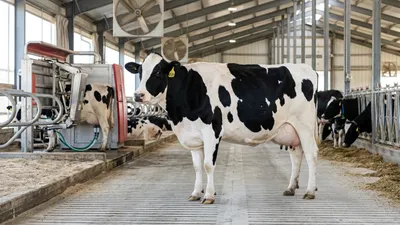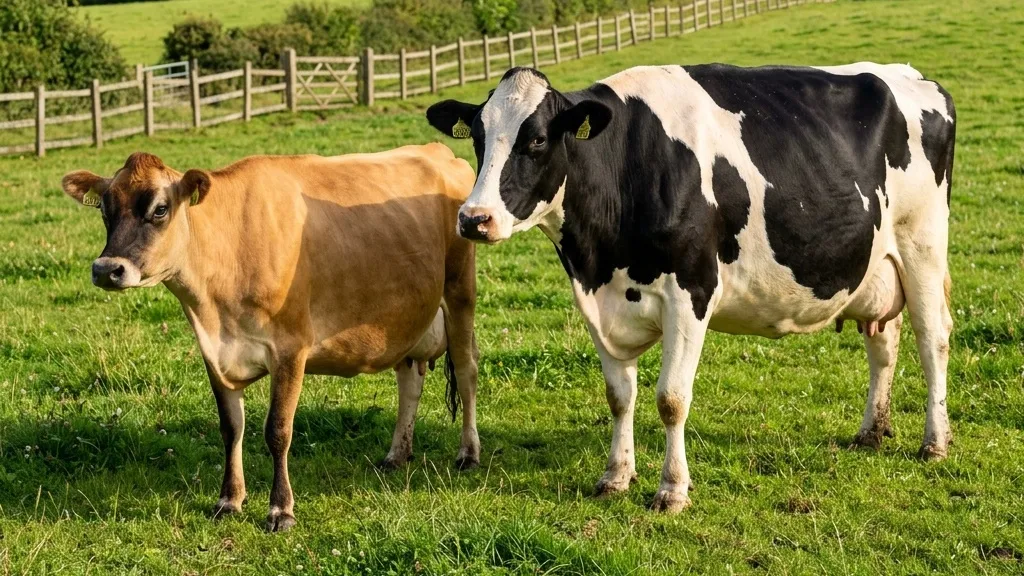
For decades, the purebred Holstein has been the undisputed queen of the dairy industry. However, rising costs, declining fertility, and health challenges have led many farmers to explore structured crossbreeding programs. But which strategy is truly more profitable: crossbred or purebred?
Quick Answer: Crossbred vs Purebred Dairy Cows
Purebred Holsteins produce the highest peak milk volume, but crossbred cows usually generate higher lifetime profit thanks to hybrid vigor — better fertility, fewer metabolic diseases, lower vet bills, and longer productive lives. Structured systems like ProCROSS (Holstein × Montbéliarde × Viking Red) maintain ~86% hybrid vigor, while a Holstein × Jersey (HoJo) cross combines volume with high components and grazing efficiency.
Crossbred vs Purebred at a Glance
The table below contrasts a high-producing purebred Holstein with a structured three-breed crossbred across the traits that drive lifetime profit rather than single-lactation volume.
| Trait | Purebred Holstein | Crossbred (e.g., ProCROSS) |
|---|---|---|
| Peak Milk Volume | Highest (30–40 L/day) | Slightly lower |
| Milk Components (Fat/Protein) | Moderate | Often higher |
| Fertility / Conception Rate | Lower | Higher (heterosis) |
| Health & Metabolic Disease | More prone (ketosis, milk fever) | Fewer issues |
| Productive Lifespan | 2.5–3 lactations | 4+ lactations |
| Lifetime Profit | Volume-driven | Typically higher |
What is Hybrid Vigor (Heterosis)?
At the core of crossbreeding is a genetic phenomenon known as hybrid vigor, or heterosis. This occurs when crossbred offspring outperform the average of their purebred parents. While heterosis has a minimal impact on highly heritable traits like milk volume, it has a massive impact on low-heritability traits—specifically health, fertility, and longevity.
This means crossbred cows generally get pregnant faster, suffer from fewer metabolic diseases, and stay in the herd longer than their purebred counterparts. The effect is largest in first-cross (F1) animals and declines with each subsequent generation unless a structured rotational system is used to maintain it.
How Much Heterosis Does Each Trait Gain?
| Trait | Heterosis Effect | Why It Matters |
|---|---|---|
| Fertility (conception rate) | High (~+20 pct units first-service) | Fewer days open, more calves, lower replacement cost. |
| Survival / Longevity | High | More lactations per cow, lower culling rate. |
| Disease resistance | High | Fewer metabolic disorders, lower vet bills. |
| Milk volume | Low (highly heritable) | Crossbreds may trail pure Holsteins slightly here. |
Popular Crossbreeding Systems
To maintain hybrid vigor over generations, farmers use structured rotational systems rather than random mixing. Some of the most successful include:
- ProCROSS: A 3-breed rotation using Holstein, Montbéliarde, and Viking Red. This system is proven to sustain an average of 86% of full hybrid vigor continuously, producing cows with high components, strong legs, and exceptional fertility.
- Holstein x Jersey (HoJo or Kiwi Cross): A very common 2-breed cross that combines the volume of the Holstein with the high fat/protein and grazing efficiency of the Jersey.
To dive deeper into breeding strategies, read our Dairy Cow Breeding and Reproduction Guide. For the parent-breed economics behind these crosses, see the Holstein vs Jersey comparison and the individual Holstein and Jersey production guides.
The 10-Year ProCROSS Study: Real Numbers
The strongest evidence for structured crossbreeding comes from a long-term University of Minnesota study following ProCROSS herds for a decade. The results are compelling for any producer weighing the lifetime-profit argument:
| Metric | ProCROSS Crossbred | Purebred Holstein |
|---|---|---|
| Daily profit | +9% | Baseline |
| Lifetime profit | +33% | Baseline |
| Cows reaching 4th lactation | 41% | 21% |
| Extra days of lifetime production | +147 days | Baseline |
| First-service conception rate | +21 pct units | Baseline |
| Days open | −41 days | Baseline |
Sources: University of Minnesota 10-year ProCROSS study; Buckley et al. (2014), "Crossbreeding: implications for dairy cow fertility and survival."
Production vs Profit: The Verdict
If your sole metric is peak fluid milk volume, the purebred Holstein still wins. However, profit is determined by income minus expenses, and this is where crossbreds shine.
Crossbred cows often win on lifetime profit due to lower veterinary bills, lower culling rates, higher conception rates, and lower feed costs (as they are often slightly smaller). Because they stay in the milking herd for more lactations, their lifetime milk yield often surpasses that of purebreds.
Whatever genetics you land on, the management levers in our how to increase milk production guide apply to both crossbreds and purebreds. To choose a starting breed, see our best dairy cow breeds guide.
To see how a shift in herd genetics could impact your bottom line, use our Dairy Profit Calculator to run the numbers for your specific farm.
Frequently Asked Questions
Are crossbred cows more profitable than purebred Holsteins?
While purebred Holsteins typically produce higher peak milk volumes, crossbred cows often generate higher lifetime profit. This is due to lower veterinary bills, higher conception rates, fewer instances of calving difficulty, and longer productive lives.
What is the ProCROSS system?
ProCROSS is a popular 3-breed rotational crossbreeding system using Holstein, Montbéliarde, and Viking Red. This combination maximizes hybrid vigor while maintaining high production, strong health traits, and excellent fertility.
What is hybrid vigor (heterosis) in dairy cattle?
Hybrid vigor, or heterosis, is the phenomenon where crossbred offspring outperform the average of their purebred parents. In dairy cattle, this is especially notable in health, fertility, and survival traits.
Do crossbred cows produce less milk than purebreds?
Generally, first-generation crossbreds may produce slightly less fluid milk than purebred Holsteins. However, their milk often has higher components (fat and protein), and their improved health and longevity mean they stay in the milking herd longer, evening out the lifetime yield.
What is a HoJo or Kiwi cross?
A HoJo or Kiwi cross refers to a Holstein x Jersey crossbreed. This popular cross combines the high milk volume of the Holstein with the high butterfat and protein content, and grazing efficiency, of the Jersey.