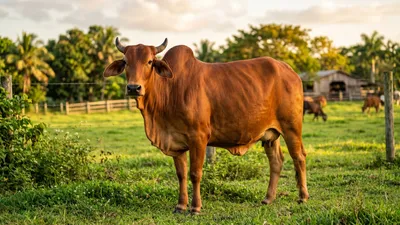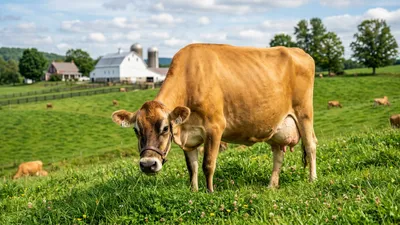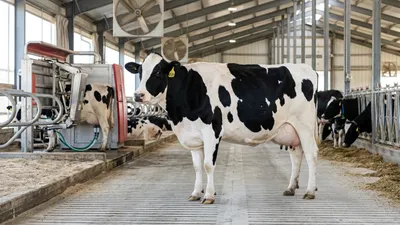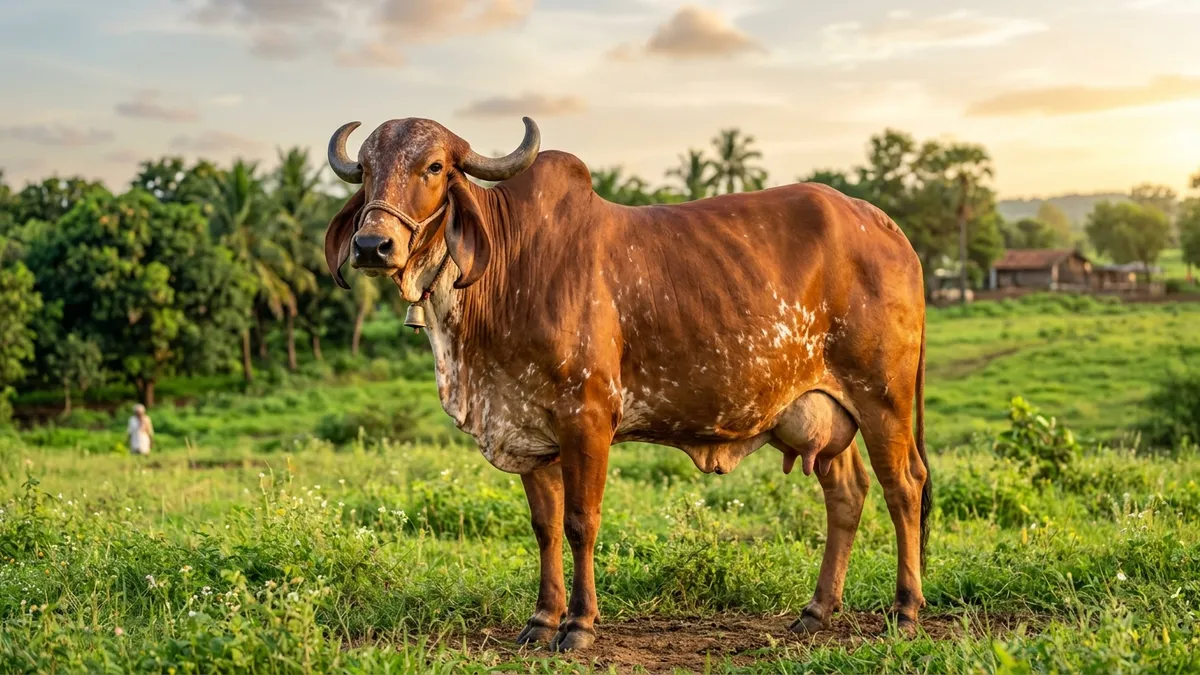
Native to the Gir forest region of Gujarat, India, the Gir cow is a globally renowned Zebu (Bos indicus) dairy breed. Highly prized for its premium A2 milk, exceptional heat tolerance, and disease resistance, the genetics of the Gir cow have shaped not just Indian dairy, but massive commercial dairy industries across South America.
Get dairy management tips weekly
Join 200+ dairy farmers getting practical KPIs, breeding insights, and profitability tips — no spam, unsubscribe anytime.
Average Yields vs. Elite Genetics
When analyzing Gir cow milk production, you must distinguish between rural subsistence farming and elite commercial breeding programs.
- Standard Field Conditions: In traditional setups with natural grazing and minimal concentrates, Gir cows average 6 to 10 litres per day, with a lactation yield of 1,800 to 2,500 litres.
- Elite Commercial Herds: Data from top breeding farms in Gujarat shows that elite Gir cows achieve a mean peak yield of 15 to 16 litres per day.
- Record Holders: Exceptional animals under intensive Total Mixed Ration (TMR) management have recorded peak yields of 20 to 23 litres per day.
| Production Level | Daily Yield | 305-Day Lactation | Typical System |
|---|---|---|---|
| Rural / Subsistence | 6–10 L/day | 1,800–2,500 L | Natural grazing, minimal concentrate |
| Commercial Optimized | 12–16 L/day | 3,000–3,500 L | Balanced ration, housing, health care |
| Elite / Record Holders | 20–23 L/day (peak) | 3,500+ L | Intensive TMR, elite genetics |
Track your own herd's peak yields and persistency with our Milk Yield Calculator.
The Brazilian Girolando Phenomenon
While India preserved the pure Gir, Brazil transformed tropical dairy farming by crossing the imported Gir with the high-yielding Holstein (Bos taurus) to create the Girolando breed (typically 5/8 Holstein, 3/8 Gir).
Girolando vs Pure Gir Yields
The Girolando combines the hardiness of the Zebu with the massive udder capacity of the Holstein. While an elite pure Gir may peak at 15–16 litres on her best days, her full lactation average is far lower — typically 1,800–2,500 litres. The average Girolando, by contrast, produces over 3,500 litres per 305-day lactation, with commercial Brazilian dairies regularly seeing daily yields of 12 to 25 litres and exceptional show-record cows exceeding 40 litres in a single 24-hour period.
A2 Milk & Nutritional Profile
In the domestic Indian market, the Gir is highly lucrative due to its 100% pure A2 milk genetics. Because they lack the A1 beta-casein mutation, Gir milk does not produce the BCM-7 peptide during digestion, allowing it to command a massive retail price premium.
| Component | Typical Gir Range | Market Advantage |
|---|---|---|
| Butterfat | 4.5% – 5.0% | Premium ghee production yield |
| SNF (Solids Not Fat) | 8.5% – 9.0% | Thicker, creamier consistency |
| Beta-Casein | A2 / A2 | Digestibility and health premiums |
Use our Milk Rate Calculator to determine exactly how much extra revenue this high-fat milk generates on standard payment grids.
Heat Tolerance & Resilience
The characteristic convex forehead and sweeping horns of the Gir are accompanied by highly functional anatomical traits. Their loose, highly vascularized skin allows for rapid heat dissipation. While Holsteins suffer severe drops in Dry Matter Intake (DMI) and milk yield at temperatures above 25°C, Gir cows continue to graze and produce milk efficiently in 40°C+ heat.
Furthermore, their skin secretes a specific lipid layer that deters ticks, drastically reducing the incidence of blood-borne diseases that devastate exotic crossbreeds in tropical climates.
Gir vs Other Indigenous Dairy Breeds
If you are choosing an indigenous A2 breed, the Gir usually competes with the Sahiwal and the Red Sindhi. Here is how they compare for a commercial tropical dairy:
| Trait | Gir | Sahiwal | Red Sindhi |
|---|---|---|---|
| Daily Yield | 8–16 L (elite 20+) | 8–12 L (elite 15–20) | 6–10 L |
| Butterfat | 4.5–5.0% | 4.5–5.5% | 4.8–5.5% |
| Milk Type | 100% A2 | 100% A2 | 100% A2 |
| Heat / Tick Resistance | Excellent | Excellent | Very good |
| Best Known For | Highest yield potential of Zebu breeds; Girolando base | India's premier commercial indigenous breed | Hardiness and docility |
For full yield and management data on the alternative, read our Sahiwal milk production guide.
Running a Commercial Gir Dairy
To move a Gir herd from subsistence yields toward the 12–16 L/day commercial tier, three levers matter most:
- Nutrition: A high-producing Gir still eats less than an exotic, but she needs a balanced concentrate (16–18% crude protein) plus quality roughage and a mineral mix to sustain peak yield. Feeding management is the single biggest gap between rural and commercial results.
- Health & Housing: Well-ventilated, east-west oriented sheds with deep bedding reduce heat load and lameness. Daily water availability of 80–100 L/cow supports lactation in hot weather.
- Genetics & Recording: Retain only daughters of high-yielding, tested A2/A2 bulls. Individual milk recording lets you identify top cows for breeding and cull underperformers — the foundation of any genetic gain program.
Because Gir milk is 100% A2, it commands a retail premium. Our A2 milk breeding guide explains how to verify and market that premium, and our milk production in India guide puts Gir yields in national context.
To capture the full value of Gir A2 genetics, see our A2 milk breeding guide. For the wider tropical-breed picture, compare the Gir against the Sahiwal and read milk production per cow in India. To choose between indigenous and exotic genetics, see our best dairy cow breeds guide. To lift yields across any breed, apply the levers in our how to increase milk production guide.
Frequently Asked Questions
How much milk does a Gir cow yield per day?
In traditional Indian farming setups, a pure Gir cow yields 6 to 10 litres per day. However, elite genetics on commercial farms consistently yield 15 to 16 litres, with champion cows producing upwards of 23 litres per day during peak lactation.
What is the Girolando breed in Brazil?
The Girolando is a highly successful crossbreed developed in Brazil (Holstein x Gir). It combines the massive milk volume of the Holstein with the heat and tick resistance of the Gir, averaging 12 to 30+ litres per day in tropical climates.
Is Gir cow milk A2?
Yes, pure Gir cow milk is 100% naturally A2 milk. It lacks the A1 beta-casein protein mutation, meaning it does not break down into the inflammatory BCM-7 peptide, making it a premium health product.
What is the fat percentage in Gir cow milk?
Gir milk is rich in butterfat, typically ranging from 4.5% to 5.0%, making it highly efficient and profitable for producing traditional A2 ghee and dairy sweets.
Why are Gir cows exported to Brazil?
Brazil imported Gir genetics to improve the heat tolerance and disease resistance of their dairy herds in tropical regions. Through decades of careful genetic selection, Brazil has developed some of the highest-yielding Zebu genetics in the world.