DHIA Milk Testing for Small Dairies: What It Costs, When It's Worth It, and What to Do With the Data
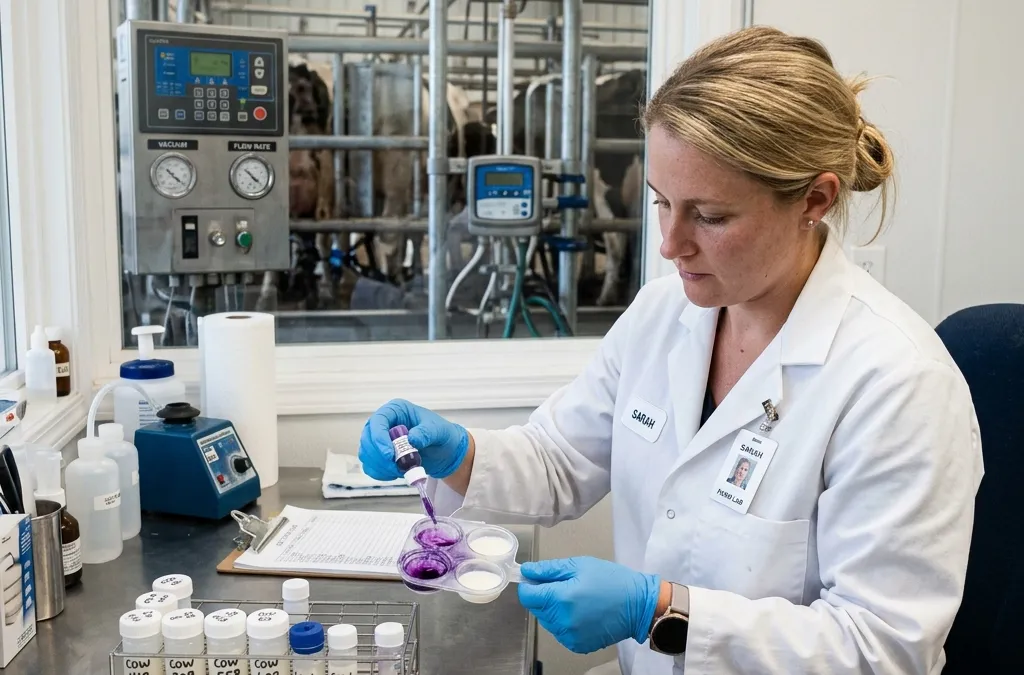
Around $25 per cow per year. That's the number every small dairy weighs before enrolling in DHIA — and the honest answer is that the money is the easy part. The hard part is that test-day data only pays you back if you actually work it between tests.
This guide is written for the 10–100 cow farm trying to decide whether official milk recording is a big-dairy thing you can skip. We'll cover what DHIA actually is, what it really costs at your size, the math that makes it worth enrolling, how to read the numbers, and — the part nobody tells you — what to do on the 29 days between test days.
Sources: Penn State Extension (DHIA-202 review; ~$25/cow/yr figure), Lancaster DHIA field-service value math, Minnesota DHIA service options, Dairy One test-plan documentation. Costs vary by association — confirm current rates with yours.
Get dairy management tips weekly
Join 200+ dairy farmers getting practical KPIs, breeding insights, and profitability tips — no spam, unsubscribe anytime.
What DHIA actually is (and the acronym soup)
DHIA — Dairy Herd Improvement Association. Local organizations that enroll herds, dispatch testers, and manage the testing program. Your samples and weights end up at a records center that computes official lactation records: DRMS serves the eastern US (now owned by Valley Agricultural Software), AgriStats the western US, and Lactanet Ontario & Western Canada.
The words you'll hear:
- DHI — the improvement program itself.
- DHIR — the registry-recognized record-keeping used for official production awards; heavily used by dairy-goat keepers (ADGA/American Goat Society).
- Test day — your one official snapshot per month: every cow weighed, milk sampled for fat/protein/SCC.
- 292 report — the per-cow test-day page. 202 sheet — the herd-vs-benchmark management page.
- Owner sampler — you collect and mail samples yourself instead of paying a tech's visit.
The most important structural fact for a small farm: your data lives at the records center, not in any software company's vault. That changes what "switching systems" costs you — and it's why good apps import DHIA data rather than making you retype it.
What it really costs a small herd
| Item | Typical cost | Notes |
|---|---|---|
| Standard monthly test, certified tech | ~$20–$30/cow/yr | Penn State cites ~$25/cow/yr as typical |
| Owner-collected samples | Lower per-cow | Cuts the visit fee; adds your time + shipping supplies |
| More frequent plans (2×/week, A-4/A-5 style) | Premium | Higher accuracy per cow per day; more per year |
| Very small herds (5–15 head) | ~$30/mo all-in reported | Small-farm owners report ~$30/mo with software-assisted entry + shipping; minimums bite at low cow counts |
| Registry/DHIR awards paperwork | Varies | Official sampling required for milk stars and production awards |
Put that in farm money: testing 50 cows costs roughly the same as one vet treatment call per month. The question was never really the fee.
Is it worth it under 100 cows? Do this math.
Lancaster DHIA frames the classic case: a cow bred back after an extra open month is roughly $100 of lost milk income per cow per year. Cut your herd's calving interval from 14 months to 13 and that's $100 × your milking herd — $10,000/year on 100 cows. Test-day reproductive data is how you find those days-open cows at all.
Where the value comes from on a small dairy
- Benchmarking: the 202 sheet tells you whether your SCC, conception rate, or cull rate is a personal problem or an industry pattern.
- Genetics & awards: official lactations raise breeding values, register for milk stars, and make your surplus stock sellable — important for 40-cow farms selling bred heifers.
- Milk quality premiums: SCC trends catch a mastitis problem in the bulk tank before it costs the premium check.
- Advisors work in it: your nutritionist and vet read DHIA reports — data they can act on is advice you actually get.
- Buyer credibility: test-day records are the difference between "good milk" and proof.
When to skip it: fewer than ~5 animals with no registry goals, or when you simply won't look at the reports. An unread test day is $25/cow of theater. Record with an app, test when the numbers drive decisions — that's the small-farm order of operations.
Test Day Tells You What the Month Did — Track What It's Doing
Between official tests, DairyFarmManager keeps daily per-cow records and imports your DHIA data onto every profile, so the 202 sheet isn't your only mirror.
Learning the 202 sheet in five minutes
Extension's advice is to read the 202 by setting benchmarks and watching trends. The handful of lines worth your life:
- Herd level: milk per cow/day, 305-day fat + protein, rolling herd average.
- Milk quality: bulk tank SCC and the count of cows above 200,000 cells.
- Reproduction: average days open, conception rate, voluntary waiting period compliance.
- Transition: fresh-cow trouble and peak yields — where a small herd's whole lactation is won or lost.
- Culling: why cows left the herd; "other" hiding real losses.
Your own records don't have to be worse than official ones to help — see the SCC guide for the threshold numbers and the KPI guide for benchmarks per metric.
The 29 days between test days — where the money actually moves
Here's the small-dairy truth: a monthly snapshot is a rear-view mirror. The cows that made your 202 sheet worse are the ones you didn't catch between tests:
| Event | If found in a week | If found at next test day |
|---|---|---|
| Missed heat | Breed on schedule | 21+ extra days open ≈ $84–$150 |
| Early mastitis | Strip, treat, ~$50–$100 | Clinical case + dumped milk $200+, SCC penalty for the month |
| Feed refusal / downer cow | Vet the same day | Severely down cow: salvage or worse |
| Yield 20% below curve | Check ration, udder, calving | 30 days of lost peak never come back |
This is exactly why the records-then-testing stack matters: daily app records (or a disciplined paper log) feed the same decisions. And when you do enroll, DairyFarmManager imports your DHIA test data onto cow profiles so the monthly snapshot and daily records finally live in the same place — instead of the 292 sheet going into a drawer.
Estimate What Better Records Change
Days open, mastitis caught late, and untracked feed costs are the leaks the ROI calculator is built around.
Launch ROI Calculator →How to enroll: five steps
Enrollment roadmap (allow ~1 month to first test)
- Find your DHIA and records center. Search "DHIA + your state" — the association will name your center (DRMS / AgriStats / Lactanet) and current test plans.
- Sign the membership agreement. Herd size, parlor type, milking times; you receive a herd code.
- Choose your plan and sampling route. Certified-tech visit vs owner-collected; monthly is the sensible default. Ask what your frequency qualifies for (milk stars, registry awards).
- Prepare for the first test day. Accurate weights, timed samples, dry cows listed, udder fill managed. A sloppy first test skews your baselines.
- Set a monthly data ritual. 15 minutes with the 202 + 292s on the same day each month. This step is the difference between paying for records and getting value.
Frequently asked questions
How much does DHIA milk testing cost?
In the US, expect roughly $20–$30 per cow per year for standard monthly testing — Penn State Extension cites about $25/cow/year as typical. Costs vary by association and test plan: more frequent tests (every 2 weeks, or A-4/A-5 type plans) and certified tech visits cost more per year, while owner-collected sampling reduces the tester fee. Add shipping/sampling supplies, and small herds often land near $30/month total for a few animals.
Is DHIA testing worth it for a small dairy under 100 cows?
Usually yes, if you use the data. The classic value example: shortening a herd's average calving interval from 14 to 13 months is worth about $100 per cow per year — $10,000 on a 100-cow farm, mostly from better reproductive tracking. Testing also unlocks genetic evaluation, registry awards and milk-star programs, and buyer credibility. The catch: test-day data that sits in a drawer is worth nothing — its value comes from what you track between tests.
What's the difference between DHIA, DHI, and DHIR?
DHIA is the local Dairy Herd Improvement Association that manages enrollment and testers; DHI (Dairy Herd Improvement) is the national program and data standard; the records center (DRMS in the East, AgriStats in the West, Lactanet in Canada) actually processes your data. DHIR is the registry-recognized version (heavily used for goats) required for official production awards and milk stars. In everyday use farmers say 'DHIA' for the whole testing system.
What is the DHIA-202 and do I need to understand it?
The DHIA-202 is the herd benchmark sheet — it compares your herd's milk, fat/protein, somatic cell count, conception rate, days open, and culling against regional and national herds. Yes, learn to read it: it's the cheapest management consulting a small dairy can get. Focus on the trendlines, not one month's numbers.
Can I do DHIA testing myself without a tester?
Yes — 'owner sampler' or 'owner collector' programs let you take and mail samples yourself under your association's rules. You save the certified-tester visit fee and gain flexibility; some registry awards and milk stars require official sampling, so check your association if awards matter. Owner sampling plus a records app is a common low-cost stack on small farms.
Will I lose my DHIA history if I change software — or stop testing?
No. Your test-day history lives at the records center (DRMS/AgriStats/Lactanet), not inside any herd software. That's one reason modern apps import it rather than asking you to re-key it: DairyFarmManager brings your DHIA data onto every cow's profile. If you stop testing one season, keep recording milk weights daily and the official history resumes later.
Do raw-milk and herdshare farms still need DHIA-style records?
Many do the hygiene-side testing themselves (coliform and standard plate count under programs like RAWMI) rather than full DHIA enrollment — but the per-cow production and treatment records are just as valuable, especially for buyers who ask. See our raw milk records checklist for what that record book should contain.
Keep Daily Records That Match the Rigor of Test Day
Per-cow yields, breeding dates, treatments and withdrawal alerts — on your phone, offline, free for up to 10 cows. Then let DHIA verify the year.
 Management
Selling Raw Milk: Records & Compliance
The five-file records stack small D2C dairies need to stay legal: RAWMI standards, withdrawal logs, herdshare paperwork, inspection prep.
Read Guide → Management
How to Start a Dairy Farm: The Complete 2026 Guide
Comprehensive step-by-step guide to starting a dairy farm. Covers startup costs, choosing breeds, essential equipment, feeding, and operations.
Read Guide → Management
Dairy Farm KPIs: The Complete Metrics Guide (2026)
Master every dairy farm KPI — from IOFC and profit margins to SCC and pregnancy rates. Learn what to measure and industry benchmarks.
Read Guide →