
Somatic cell count is the single most important indicator of milk quality and udder health in dairy farming. Yet many farmers only learn about SCC when a cooperative penalty notice arrives. Understanding what SCC measures, what the numbers mean, and how to act on them can save your farm thousands of dollars every year � and protect the long-term health of your herd. In this guide, we explain exactly what somatic cell count is, how to interpret SCC results, and the most effective strategies to reduce high SCC in your herd.
What Does Somatic Cell Count Mean?
Somatic cells are white blood cells (leukocytes) that naturally exist in milk. They are part of the cow's immune system. When the udder is healthy, SCC remains low � typically under 100,000 cells/mL. When bacteria enter the udder and cause mastitis (an infection of the mammary gland), the cow's immune response floods the milk with somatic cells to fight the infection. The higher the SCC, the more severe the infection.
What's Inside Somatic Cells?
Somatic cells are not a single type. The composition of the cell population tells you about the nature of the infection:
- Neutrophils (50�80%): The first responders. Elevated neutrophils indicate acute bacterial infection � they rush to the udder within hours of bacterial entry
- Macrophages (10�25%): Clean-up cells that engulf bacteria and dead tissue. Elevated macrophages indicate chronic or resolving infection
- Lymphocytes (5�15%): Part of the adaptive immune system. Elevated lymphocytes suggest a persistent, long-term infection
- Epithelial cells (<5%): Udder tissue cells shed into milk. High epithelial cell counts indicate tissue damage beyond the infection itself
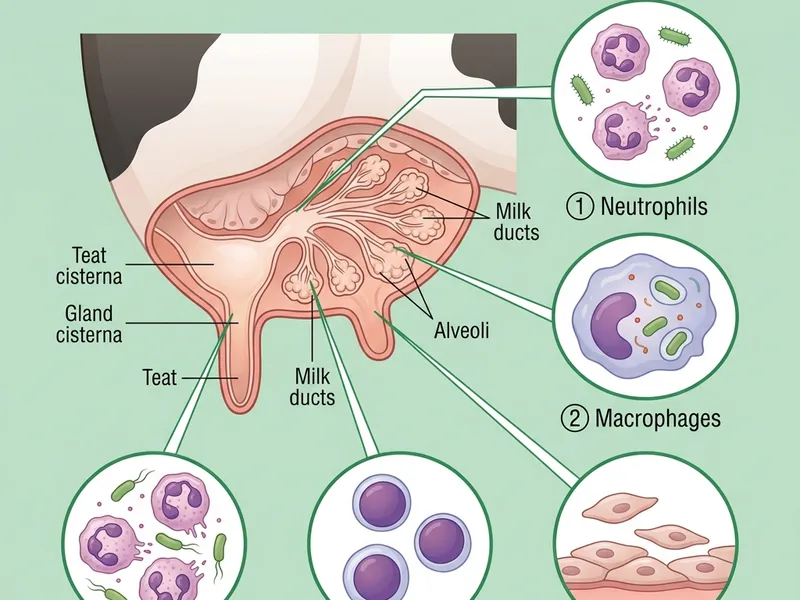
Understanding this composition helps veterinarians diagnose whether an infection is acute, chronic, or resolving � and guides treatment decisions. Research published in the Journal of Dairy Science has shown that neutrophil-to-macrophage ratios can predict treatment success rates.
SCC is measured in cells per milliliter (cells/mL) of milk. It is the standard metric used by dairy cooperatives, veterinarians, and farmers worldwide to assess milk quality and udder health. Every bulk tank of milk delivered to a processor is tested for SCC � and the results directly affect how much the farmer is paid. For a deeper understanding of how milk quality metrics tie into your farm's financial performance, see our guide to essential dairy farm KPIs.
Key Concept
SCC = White Blood Cells in Milk (cells/mL)
SCC is not just a quality metric. It is a financial metric. High SCC means lost milk production, cooperative penalties, treatment costs, and premature culling. The relationship is direct and measurable: for every 100,000 increase in bulk tank SCC above 200,000, you lose approximately 2.5 kg of milk per cow per day.
Why SCC Matters: The Financial Impact
The impact of high SCC on a dairy farm is both immediate and cumulative. Here is what elevated somatic cell count costs you:
- Lost milk production: Subclinical mastitis reduces milk yield by 2.5 kg per cow per day per 100,000 increase in SCC above 200,000
- Cooperative penalties: Most cooperatives penalize at SCC above 400,000, with increasing deductions at 500,000 and 750,000+
- Foregone premiums: Many cooperatives offer quality bonuses for SCC below 200,000 � high SCC means you lose these bonuses
- Treatment costs: Clinical mastitis requires veterinary intervention, antibiotics, and sometimes hospital pens
- Premature culling: Chronically high-SCC cows are often culled early, replacing productive animals
- Reduced milk components: High SCC reduces protein content (especially casein), affecting cheese yield and manufacturing properties
These costs compound with other farm expenses. When high SCC reduces milk revenue, your feed cost per litre of milk increases � meaning you're spending more per unit of production. For a detailed breakdown of how feed costs interact with milk quality metrics, see our guide to calculating feed cost per litre of milk.
Calculate Your SCC Costs
See exactly how much high somatic cell count costs your farm in penalties, lost production, and foregone premiums. Enter your herd details and get an instant financial impact report.
Open SCC Penalty Calculator ?
Calculate Your SCC Costs
See exactly how much high somatic cell count costs your farm in penalties and lost production.
How to Interpret SCC Results
Understanding SCC benchmarks helps you assess where your herd stands and what action is needed. Here are the standard thresholds used by dairy cooperatives and veterinarians worldwide:
| SCC Range (cells/mL) | SCS | Status | What It Means |
|---|---|---|---|
| < 100,000 | < 3.0 | Excellent | Quality premium bonus, optimal production. Top-tier herds with excellent udder health protocols. |
| 100,000 � 200,000 | 3.0 � 4.0 | Good | Minor production loss, may qualify for premium. Well-managed herds with effective mastitis control. |
| 200,000 � 300,000 | 4.0 � 4.6 | Warning | Noticeable production loss, ~15% herd infected. Action needed to prevent further escalation. |
| 300,000 � 400,000 | 4.6 � 5.0 | Penalty | Cooperative penalties begin, ~22% herd infected. Urgent intervention required. |
| > 400,000 | > 5.0 | Critical | Heavy penalties, milk rejection risk, urgent action needed. Contact your veterinarian immediately. |
Individual Cow vs. Bulk Tank SCC
There are two ways SCC is measured on a dairy farm:
- Individual cow SCC: Measured during milk recording (e.g., through a herd management system like PCDart or DairyComp). This identifies which specific cows have elevated SCC and need attention.
- Bulk tank SCC: The combined SCC of all milk in the bulk tank. This is what cooperatives test and what determines your payment. It reflects the overall herd health status.
A single cow with high SCC can significantly elevate the bulk tank SCC � especially in smaller herds. A 100-cow herd where one cow has an SCC of 1,000,000 will see the bulk tank rise by approximately 10,000 cells/mL. In a 50-cow herd, that same cow pushes the bulk tank up by 20,000 cells/mL.
Somatic Cell Score (SCS): The Linear Scale
Because SCC values range from very low (50,000) to very high (millions), the industry uses Somatic Cell Score (SCS) to convert the logarithmic SCC scale into a linear 0�9 scale. This makes it easier to compare and track changes over time.
SCS Formula
SCS = log2(SCC / 100,000) + 3
Each unit increase in SCS roughly corresponds to a doubling of the cell count. An SCS of 4.0 corresponds to an SCC of 200,000. An SCS of 5.0 corresponds to an SCC of 400,000. Most genetic evaluations and breeding values use SCS rather than raw SCC because of its linear properties.
| SCS | Approximate SCC | Interpretation |
|---|---|---|
| 2.0 | 50,000 | Excellent � very low cell count |
| 3.0 | 100,000 | Excellent � optimal production |
| 4.0 | 200,000 | Good � minimal production loss |
| 4.6 | 300,000 | Warning � ~15% herd infected |
| 5.0 | 400,000 | Penalty � cooperative penalties begin |
| 6.0 | 800,000 | Critical � urgent action required |
What Causes High Somatic Cell Count?
High SCC is caused by mastitis � an infection of the mammary gland. The causes fall into two broad categories:
Contagious Mastitis
Spread from cow to cow during milking. The most common contagious pathogens are Staphylococcus aureus and Streptococcus agalactiae. These bacteria colonize the udder and spread through milking equipment, hands, and towels. Contagious mastitis is the primary reason bulk tank SCC remains persistently elevated despite good environmental hygiene.
Environmental Mastitis
Caused by bacteria in the cow's environment � bedding, flooring, water, and manure. Common environmental pathogens include E. coli, Klebsiella, and Streptococcus uberis. Environmental mastitis tends to cause acute clinical cases rather than chronic subclinical infections, but it still contributes to elevated SCC.
Other Contributing Factors
- Incomplete milking: Residual milk in the udder provides a breeding ground for bacteria
- Poor udder prep: Inadequate cleaning before milking allows bacteria to enter
- Worn liners: Damaged or old milking liners fail to provide proper teat sealing
- Stress and immune suppression: Heat stress, overcrowding, and poor nutrition weaken the cow's immune response
- Chronically infected cows: Cows that never fully recover become persistent sources of infection
How to Reduce High SCC
Reducing bulk tank SCC requires a systematic approach targeting both contagious and environmental mastitis. Here are the most effective strategies:
Identify and Cull Chronically Infected Cows
Cows with persistently high SCC (consistently above 400,000) are the biggest contributors to bulk tank elevation. Use milk recording data to identify these cows. If they don't respond to treatment within two lactations, culling is often the most cost-effective decision.
Implement Pre- and Post-Milking Teat Disinfection
Pre-dipping kills bacteria on the teat surface before milking. Post-dipping seals the teat canal and prevents new infections. Use iodine-based or chlorhexidine-based disinfectants. This single intervention can reduce new infection rates by 30�50%.
Milk Infected Cows Last
If you know which cows have elevated SCC, milk them last in the milking order. This prevents the milking equipment from transferring bacteria from infected cows to healthy ones. Use color-coded leg bands or marks to identify high-SCC cows.
Improve Bedding Hygiene
Environmental mastitis originates in the cow's housing area. Keep bedding dry and clean. Sand bedding generally supports lower SCC than organic beddings (straw, sawdust) because it dries faster and harbors fewer bacteria. Clean stalls at least once daily.
Maintain Milking Equipment
Worn liners, cracked tubing, and malfunctioning pulsators create conditions that promote bacterial growth and incomplete milking. Replace liners according to the manufacturer's schedule (typically every 2,500�3,000 milkings). Test pulsation and vacuum levels quarterly.
Implement Dry Cow Therapy
Treat all cows at drying off with an intramammary antibiotic to eliminate existing infections during the dry period. This is one of the most cost-effective mastitis interventions. The dry period is when the udder has the best chance of healing from subclinical infections.
Perform Regular Milk Recording
You cannot manage what you don't measure. Monthly or quarterly milk recording gives you individual cow SCC data, allowing you to identify problem cows early, track the effectiveness of interventions, and make informed culling decisions.
Consult Your Veterinarian
A veterinarian can help you develop a customized mastitis control plan for your specific farm. This may include culture-based testing to identify the specific pathogens in your herd, targeted treatment protocols, and vaccination strategies.
See Your Savings Potential
Use the What-If scenario in the SCC Penalty Calculator to see how much you'd save by reducing your bulk tank SCC to target levels. Enter your current SCC and target SCC to get a personalized savings estimate.
Open SCC Penalty Calculator ?SCC and Milk Components
High SCC doesn't just reduce milk volume � it also affects milk composition. Research has consistently shown that elevated SCC is associated with:
- Reduced protein content: Especially casein, which is critical for cheese manufacturing. Every 100,000 increase in SCC above 200,000 reduces casein by approximately 0.01�0.02%
- Slightly reduced butterfat: Though the effect is less pronounced than on protein
- Increased whey protein ratio: Damaged udder tissue releases more whey proteins into the milk
- Altered mineral balance: Increased sodium and chloride, decreased lactose
This is why some cooperatives apply component-based penalties in addition to volume-based penalties for high SCC milk. If your milk is used for cheese production, high SCC directly reduces the manufacturer's yield and quality.
Legal SCC Standards by Country
Every major dairy-producing country sets legal limits on bulk tank SCC. These are not guidelines � they are regulatory thresholds. Milk above these limits cannot be sold for human consumption in most jurisdictions.

| Country/Region | Legal Limit (cells/mL) | Grade A Premium Below | Notes |
|---|---|---|---|
| United States | 750,000 | < 350,000 | Federal Grade A limit; many cooperatives enforce stricter internal limits of 400,000�500,000 |
| European Union | 400,000 | < 200,000 | EU hygiene regulations; lower than US, reflecting stronger emphasis on udder health |
| Canada | 500,000 | < 250,000 | Canadian Dairy Commission limit; provincial cooperatives may enforce lower thresholds |
| Australia | 500,000 | < 200,000 | Industry voluntary target of 250,000; Fonterra and other processors enforce 400,000 |
| New Zealand | 400,000 | < 200,000 | Fonterra supplier requirement; seasonal variation managed through winter milking protocols |
| India | 500,000 | < 200,000 | FSSAI standard; cooperatives like Amul enforce 300,000 for premium procurement |
The gap between legal limits and cooperative payment thresholds is important. Even if your bulk tank is legally compliant, cooperatives often impose their own penalties well below the legal maximum. For example, in the US, while the federal limit is 750,000, most cooperatives begin penalizing at 400,000 and apply steeper deductions above 500,000. Some cooperatives offer premium bonuses for SCC below 200,000 � effectively creating a financial incentive band between 100,000 and 400,000 where every improvement in SCC translates directly to better milk pricing.
How is SCC Measured?
There are three primary methods for measuring somatic cell count, each serving a different purpose on the dairy farm:

California Mastitis Test (CMT)
A rapid, on-farm screening test. A small sample of milk is mixed with a reagent that reacts with DNA from somatic cells. The mixture forms a gel � the thicker the gel, the higher the SCC. CMT is cheap, fast, and gives a rough estimate (low/medium/high) but cannot provide an exact cell count. It is most useful for screening individual quarters of the udder to identify which quarters are infected.
Dairy Herd Improvement (DHI) Testing
The gold standard for individual cow SCC. Milk samples are collected during regular milk recording and sent to a certified laboratory where electronic counters provide precise cell counts. DHI data feeds into herd management software and is used for genetic evaluations, culling decisions, and tracking treatment efficacy. Most dairy cooperatives and breed associations rely on DHI data. For more on how DHI data fits into your farm management, see our guide to dairy herd management software.
Inline Sensors
Modern milking systems (e.g., Lely, DeLaval, GEA) can measure SCC in real-time using conductivity or optical sensors. These systems provide continuous monitoring of individual cow SCC at every milking. While less precise than DHI laboratory testing, inline sensors offer the advantage of immediate detection � alerting you to SCC spikes within hours rather than weeks. This is particularly valuable for detecting clinical mastitis early and preventing bulk tank contamination.
Track Your SCC Costs Over Time
Whether you use DHI testing or inline sensors, the SCC Penalty Calculator helps you translate those cell counts into real dollar impact. Enter your latest bulk tank SCC and see your current costs � then use the What-If scenario to plan your improvement targets.
Open SCC Penalty Calculator ?Seasonal Patterns in SCC
SCC tends to follow seasonal patterns that every dairy farmer should be aware of:
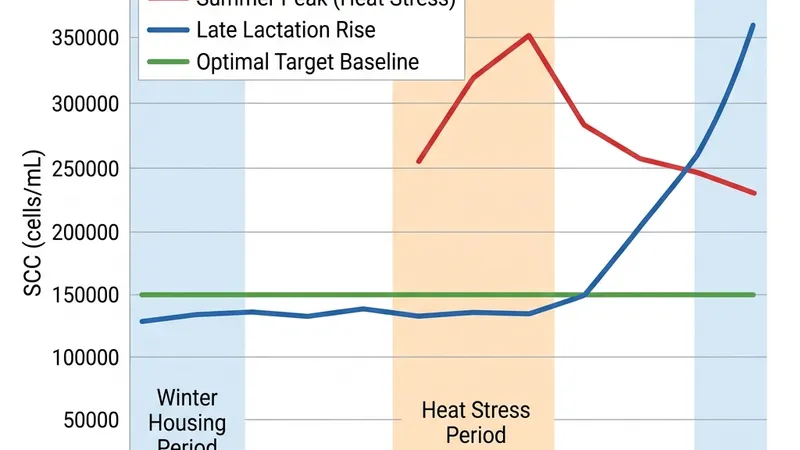
- Summer peak: Heat stress weakens the immune system, flies spread bacteria, and environmental conditions favor bacterial growth. Many herds see SCC rise 10�20% during summer months.
- Late lactation rise: As lactation progresses, SCC naturally increases. Cows in late lactation typically have higher SCC than early-lactation cows.
- Winter housing: Indoor housing during winter concentrates cows in closer proximity, increasing environmental exposure and contagious spread.
Plan your mastitis control interventions around these seasonal patterns. Increase monitoring during summer, improve housing hygiene during winter, and use dry cow therapy to reset SCC at the start of each lactation.
SCC and Reproductive Performance
The impact of high SCC extends beyond milk production and penalties � it directly affects reproductive performance. Research from the University of Wisconsin and published in the Journal of Dairy Science has demonstrated clear links between elevated SCC and reduced fertility:
- Delayed conception: Cows with chronic mastitis (SCC > 400,000) take 15�25 more days to conceive than healthy cows, extending the calving interval and reducing lifetime production
- Reduced heat expression: High-SCC cows show weaker or silent heats, making estrus detection harder and reducing timed AI success rates
- Impaired embryo quality: Systemic inflammation from mastitis can impair oocyte quality and early embryo development, reducing conception rates by 5�15%
- Increased embryonic loss: Inflammatory mediators (prostaglandins, cytokines) released during mastitis can interfere with early pregnancy maintenance
The economic impact compounds: a cow that conceives 20 days later produces less milk over her lactation, and a cow that fails to conceive is eventually culled. Reducing bulk tank SCC is therefore not just a milk quality decision � it is a reproductive management strategy. For more on managing herd reproduction, see our guide to calculating calving dates.
Reproductive performance and udder health are deeply connected. For a full guide to heat detection, breeding timing, and reproductive KPIs, read our dairy cow breeding and reproduction guide.
Frequently Asked Questions
What is a normal somatic cell count for dairy cows?
A bulk tank SCC below 100,000 cells/mL is excellent. 100,000�200,000 is good, 200,000�300,000 is moderate, 300,000�400,000 is a warning, and above 400,000 triggers cooperative penalties. Individual cow SCC below 200,000 is considered normal; above 250,000 suggests subclinical mastitis.
What causes high somatic cell count in milk?
The main causes are: (1) contagious mastitis spread during milking (Staph aureus, Strep agalactiae), (2) environmental mastitis from dirty bedding or housing (E. coli, Klebsiella), (3) incomplete milking procedures, (4) poor udder prep, (5) worn or damaged liners, (6) stress and immune suppression, and (7) chronically infected cows spreading infection to healthy cows.
How does high SCC affect milk production?
Every 100,000 increase in bulk tank SCC above 200,000 results in approximately 2.5 kg of milk lost per cow per day. This is due to reduced milk synthesis in infected quarters, increased culling of high-SCC cows, and subclinical mastitis reducing overall herd productivity.
What is the difference between clinical and subclinical mastitis?
Clinical mastitis shows visible signs: swollen udder, abnormal milk (clots, watery), and often reduced appetite. Subclinical mastitis has no visible signs but elevates SCC and reduces milk production. Subclinical mastitis is far more common � for every clinical case, there are typically 3�4 subclinical cases quietly costing you production and quality.
How much does high SCC cost a dairy farm?
High SCC costs farms between $2,000 and $15,000+ per 100 cows per year through lost milk production, cooperative penalties, treatment costs, and premature culling. Use the SCC Penalty Calculator to estimate your specific costs based on your herd size, yield, and bulk tank SCC.
What is Somatic Cell Score (SCS)?
SCS is a linear transformation of SCC using the formula SCS = log2(SCC/100,000) + 3. It converts the logarithmic SCC scale into a linear 0�9 scale where each unit increase roughly corresponds to a doubling of cell count. SCS above 5 indicates a significant mastitis problem requiring action.
How can I reduce my bulk tank SCC?
Key strategies include: (1) identify and cull chronically infected cows, (2) use proper pre- and post-milking teat disinfection, (3) milk infected cows last, (4) improve bedding hygiene, (5) ensure milking equipment is properly maintained, (6) implement a dry cow therapy program, (7) perform regular milk recording to track individual cow SCC, and (8) consult your veterinarian for a mastitis control plan.
Key Takeaways
- SCC measures immune response: High SCC indicates mastitis infection, not just "dirty milk"
- Every 100K above 200K = 2.5 kg/day lost: The financial impact is direct and measurable
- Subclinical mastitis is the hidden cost: For every clinical case, 3�4 subclinical cases are silently costing you production
- Prevention is cheaper than treatment: Teat disinfection, hygiene, and dry cow therapy are the most cost-effective interventions
- Monitor regularly: Milk recording is essential for identifying problem cows early
- Use the calculator: Know your specific costs so you can make informed investment decisions in mastitis control
Ready to Take Action?
Calculate your exact SCC costs, compare scenarios, and build a case for investing in mastitis control. The SCC Penalty Calculator gives you the numbers you need to make data-driven decisions.
Open SCC Penalty Calculator ?