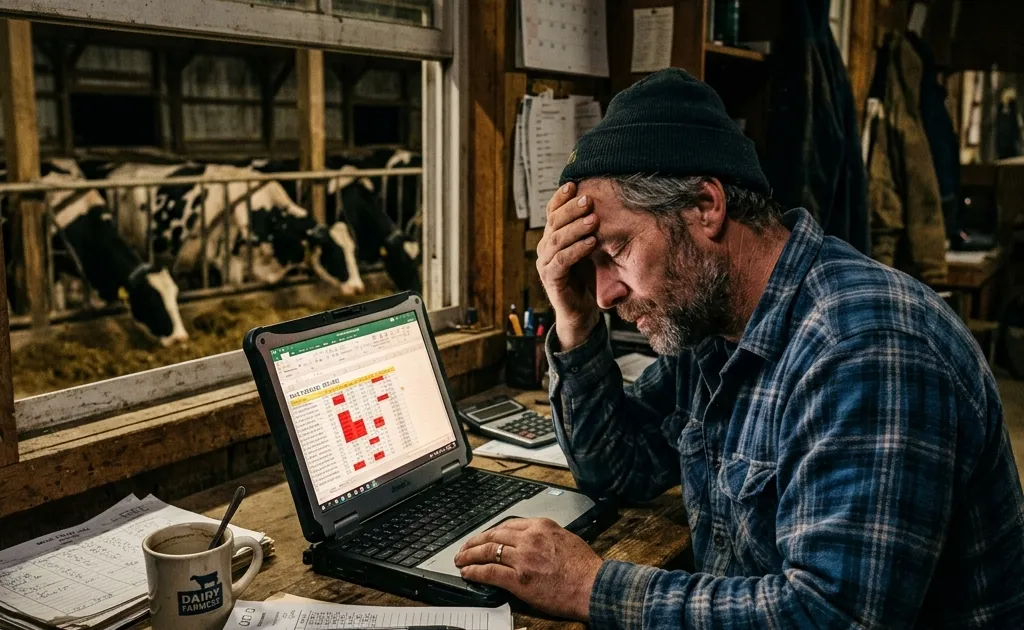
You opened Excel because it was free. You built a few columns for milk yields, added some formulas for breeding dates, and called it a system. That was two years ago. Now you're spending every Sunday evening updating rows, fixing broken formulas, and wondering why you didn't catch that cow's breeding date three weeks ago.
Here's the truth: spreadsheets aren't free. They cost you 5+ hours every week � time you could spend on your herd, your family, or your business. And the worst part? Those hours don't just cost time. They cost missed alerts, formula errors, and lost production.
Source: Penn State Extension Dairy Management Program; University of Wisconsin Dairy Records Management Systems
According to Forbes, 88% of spreadsheets contain at least one significant error. On a dairy farm, that error could be a missed breeding window, an incorrect feed calculation, or a financial report that doesn't add up. And those errors compound over time.
Source: Forbes, "Why You Should Stop Using Spreadsheets"; DairyTech.ai ERP Analysis, 2026
This article breaks down exactly where those hours go, what spreadsheets can't do that your farm actually needs, and how to make the switch in under 5 minutes.
Track your herd’s performance in one place
Log milk yield, monitor breeding, track expenses, and generate reports — all from your browser. No download needed.
The Hidden Cost of "Free"
When someone says Excel is free, they mean the software costs nothing. But your time isn't free. If you value your time at even $15/hour (well below what most farmers earn), those 5 weekly hours cost you $75/week or $3,900/year. Manually calculating complex metrics like feed cost per litre in Excel is not only time-consuming but highly prone to formula errors.
This estimate is based on Penn State Extension's dairy management time studies and University of Wisconsin's analysis of record-keeping labor costs on mid-size operations.
And that's just the direct time cost. Spreadsheet record keeping also costs you in ways that don't show up on a timesheet:
- Missed breeding windows � Spreadsheets don't send alerts. When a cow's heat detection date passes without a reminder, you lose a breeding cycle. At $15�25 per insemination, each missed cycle costs real money.
- Undetected milk drops � A cow producing 8 gallons suddenly drops to 5. In a spreadsheet, nobody notices until the monthly report. In a farm management app, you get an instant alert.
- Formula errors � One wrong cell reference can corrupt weeks of financial data. These errors often go undetected for months, leading to bad business decisions.
- Data loss � A corrupted file, an accidental overwrite, a laptop crash. If your farm records live in one Excel file, you're one accident away from starting over.
Where Your 5 Hours Actually Go
Let's be honest about what spreadsheet-based record keeping really looks like on a working dairy farm.
"I kept my herd records in Excel for three years. Every Sunday night I'd spend two hours updating formulas and checking breeding dates. When I switched to DairyFarmManager, I realized I'd been wasting time on things the app does automatically. My Sunday evenings are free now."
Weekly Time Comparison
What Spreadsheets Can't Do
Spreadsheets are great for static data entry. But dairy farming isn't static. Here are the things your Excel sheet simply cannot do � no matter how many formulas you add.
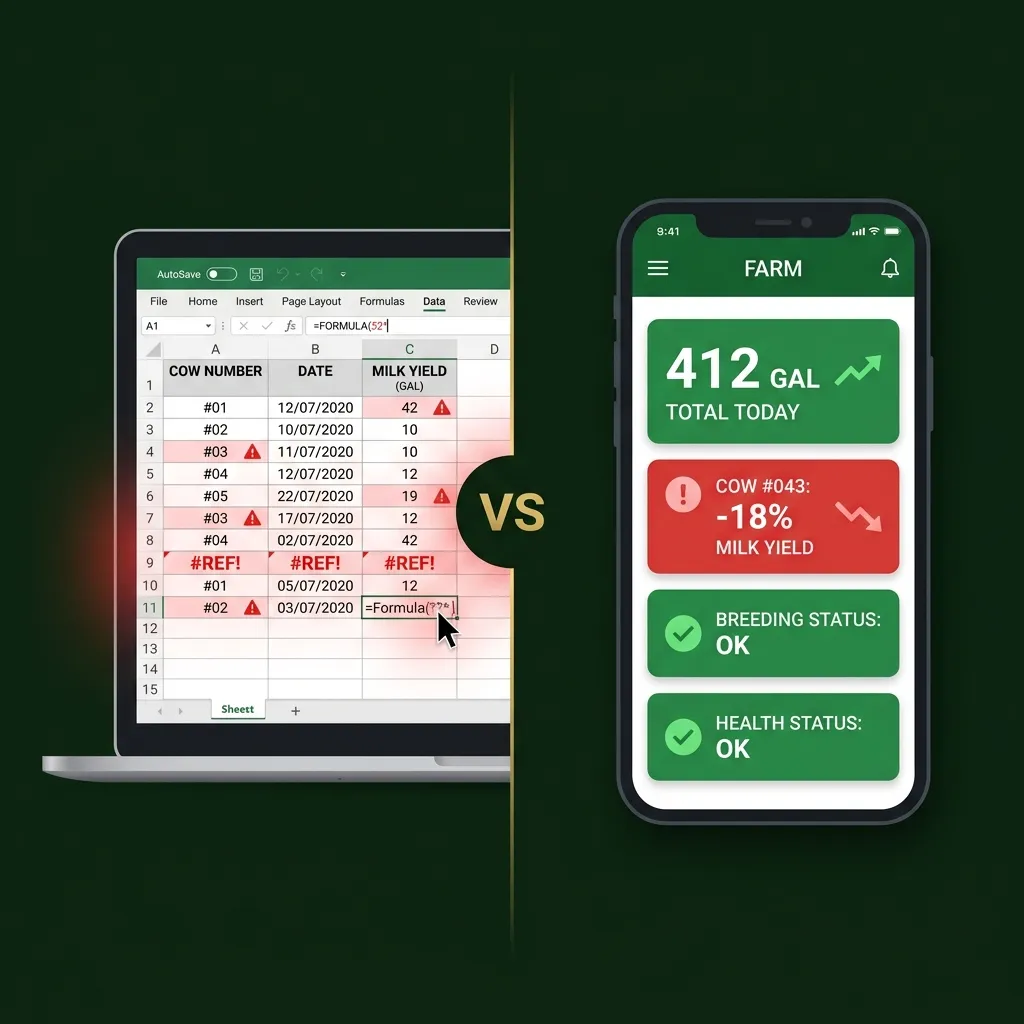
Instant Milk Drop Alerts
The app detects when a cow's production drops below her average and notifies you immediately. In Excel, you'd have to manually compare today's number against her historical average � every single day, for every single cow.
Automatic Breeding Calendar
Log insemination once. The app calculates due dates, dry-off dates, colostrum windows, and pregnancy check schedules � then sends reminders. In a spreadsheet, you're checking dates manually and hoping you don't miss one.
Records in the Barn
Log milk yield on your phone while standing next to the cow. No more walking back to the office to open a laptop. No more scribbling on paper and transcribing later. Tap twice, done in 30 seconds.
Real-Time Dashboard
See your herd's performance at a glance � total milk, top producers, upcoming breeding dates, health alerts � without building a single formula. The dashboard updates the moment you enter data.
Multi-User Access
Your farm manager, your veterinarian, and your nutritionist can all access the same data in real time. No more emailing Excel files back and forth or wondering which version is current.
Cloud Backup
Your data is automatically backed up to the cloud. A laptop crash, a spilled coffee, a stolen phone � your records are safe. With spreadsheets, one corrupted file can wipe out months of work.
The Side-by-Side Comparison
Here's a direct comparison of what you get with spreadsheets versus a dedicated farm management app.
How to Switch from Excel in 5 Minutes
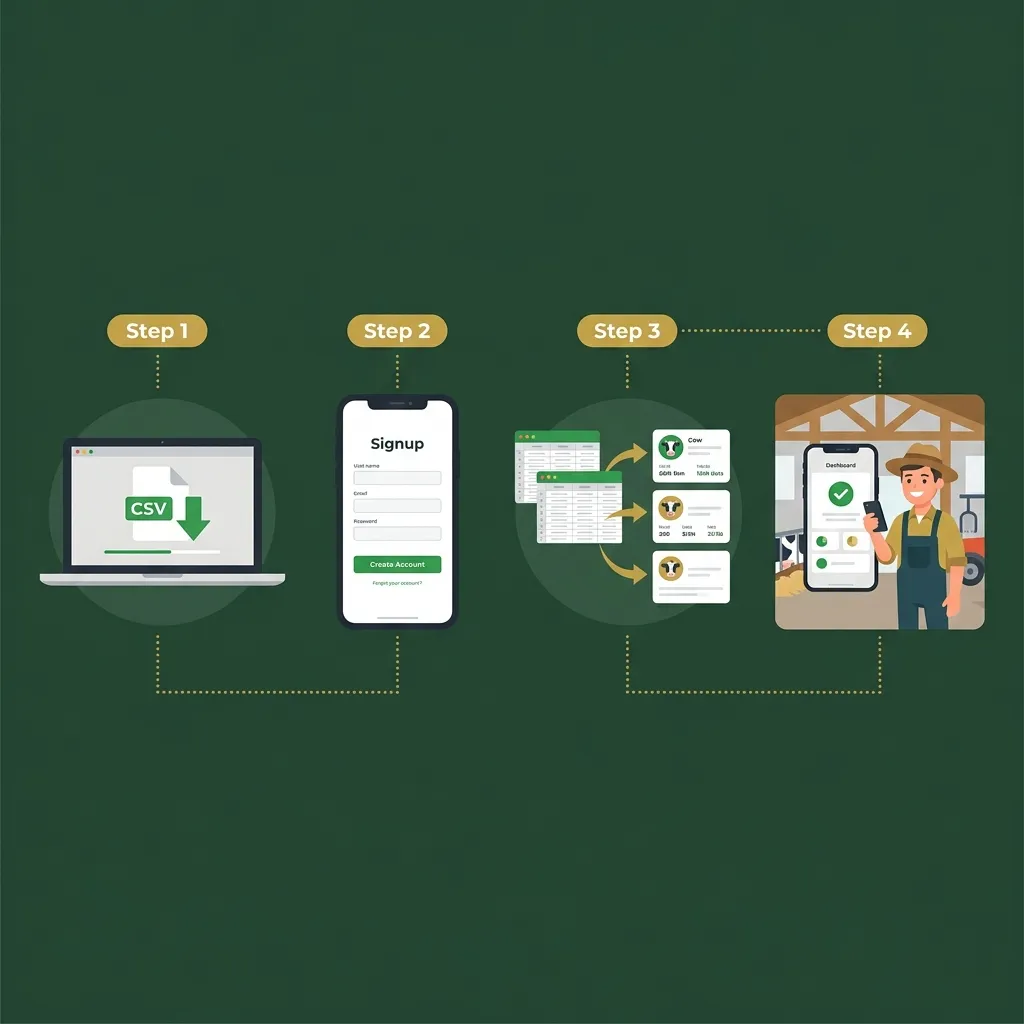
Making the switch is simpler than you think. Here's the step-by-step process.
Export your CSV from Excel
Open your spreadsheet, go to File ? Save As ? CSV. This gives you a clean data file ready for import.
Sign up for DairyFarmManager (free)
Go to app.dairyfarmmanager.com and create your account. No credit card required. Free up to 10 cows.
Import your herd data
Use the CSV import tool to bring in your existing cow records, milk logs, and breeding data. Most farmers are done in under 2 minutes.
Try it for one week
Log your daily milk yields in the app instead of Excel. After 7 days, compare the time you spent. Most farmers are shocked at the difference.
Ready to stop wasting evenings on spreadsheet formulas?
Switch from spreadsheets in under 5 minutes. Import your existing data. Free up to 10 cows � no credit card required.
See the full comparison ?Calculate Your Farm Profit
Enter your revenue and costs to see your actual profit margin and net income per cow.
Calculate Your Time Savings ROI
See how much time and money you could save by switching from spreadsheets to digital herd management.
Other Options to Consider
DairyFarmManager isn't the only option. Here's how the landscape looks (see our full dairy farm software comparison guide for a deeper breakdown):
DairyComp 305
$500�$2,000/year
The industry standard for large operations (1,000+ cows). Deep analytics, breed registry integration, DHIA support. Best for: large dairies with dedicated data managers.
BoviSync
$0.50�$3.00/cow/month
Cloud-based, mobile-first. Strong DHIA integration and parlor controller support. Best for: mid-size dairies wanting mobile access.
Cattly
Free (unlimited animals)
Free tier with unlimited animals. Simple interface, phased migration support. Best for: small dairies wanting a quick start.
Herdwatch
$119�$299/year
Mobile-first, EU compliance focus. Great for farms needing Red Tractor or assurance documentation. Best for: compliance-driven operations.
The right choice depends on your herd size, budget, and how much analytics you need. The important thing is to stop using spreadsheets � whichever alternative you choose.
Frequently Asked Questions
How much time do dairy farmers spend on spreadsheet record keeping?
The average dairy farmer spends 5�7 hours per week on spreadsheet-based record keeping. This includes daily milk logging (15 min/day), breeding tracking (30 min/week), health records (20 min/week), financial data entry (1 hour/week), and data analysis and reporting (1.5 hours/week). Digital farm management apps reduce this to under 10 minutes per day.
Can I really replace Excel with a farm management app?
Yes. Apps like DairyFarmManager, Cattly, and BoviSync handle everything spreadsheets do � milk logging, breeding tracking, health records, financial tracking � but faster and with automatic alerts. Most farmers complete the switch in under 5 minutes and can import existing CSV data.
What are the biggest risks of using spreadsheets for farm records?
The three biggest risks are: (1) missed breeding and calving reminders because spreadsheets don't send alerts, (2) formula errors that go undetected for weeks � Forbes reports 88% of spreadsheets contain at least one significant error � and (3) data loss from file corruption or accidental overwrites. A University of Wisconsin study found that farms with automated record systems had 23% fewer missed breeding windows.
What if I lose my data during the switch?
You won't lose anything if you follow a simple process: (1) keep your original Excel file as a backup, (2) export a CSV copy, (3) import into the new app, (4) verify your data looks correct before deleting anything. Most apps let you run both systems in parallel during the transition.
What if I don't have internet in the barn?
Most modern dairy farm apps work offline. DairyFarmManager, Herdwatch, and Cattly all support offline data entry � you record milk yields, health events, and breeding data without internet. The app syncs automatically when you reconnect.
What if my farm hand can't learn a new system?
If they can use a smartphone, they can use a farm management app. Most apps are designed for daily use � open, tap, done. DairyFarmManager's milk logging takes 2 taps per cow. That's simpler than opening Excel, finding the right file, and navigating to today's sheet.
Is DairyFarmManager actually free?
Yes. The Free plan lets you manage up to 10 cows with core features like daily milk logging, breeding tracking, and health records. No credit card required. For larger herds, paid plans start at $19/month.
How do I switch from Excel to farm management software?
Most farmers complete the switch in under 5 minutes. Export your Excel data as CSV, sign up for a free account, import your herd data, and start logging. The key is to keep your Excel backup until you've verified everything transferred correctly.
Get dairy management tips weekly
Join 200+ dairy farmers getting practical KPIs, breeding insights, and profitability tips — no spam, unsubscribe anytime.
 Software
 Dairy Farm Software ROI: The $17,360 Cost of Spreadsheets
Calculate the true ROI of dairy farm software. Learn why spreadsheets cost the average 100-cow dairy over $17,000 a year in missed heats, high SCC, and feed shrink.
Read Guide →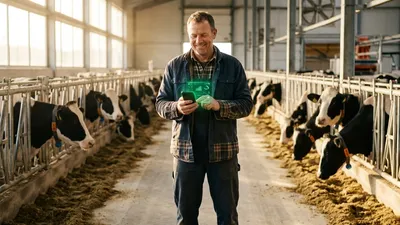 Software
 Best Dairy Farm Management App for Android (2026)
Discover the best dairy farm management app for your Android device. Track milk yield, breeding, and expenses all from your pocket.
Read Guide → Software
 PCDart Alternative 2026: How to Switch Dairy Management Software
Thinking about switching from PCDart? This guide compares DairyComp, BoviSync, and free alternatives with a switching checklist.
Read Guide →