Water is the most important nutrient for dairy cows — and often the most overlooked. A high-producing Holstein drinks 30–50 gallons per day under normal conditions, and that number can double during heat stress. When water is limited, milk production drops immediately, feed intake falls, and health problems follow. This guide covers exactly how much water your cows need, what factors drive intake, and how to size your water troughs correctly.
Key Takeaways
- Milk yield is the #1 driver — every pound of milk requires 3.2 pounds of water to produce. An 80-lb/day cow needs 25+ gallons just for milk synthesis.
- Temperature is #2 — for every degree above 68°F (20°C), water intake increases by 1–1.5 gallons per day.
- Trough size matters — if cows walk away from the trough or compete for access, subordinate cows won't drink enough.
- Monitor intake — a sudden drop in water consumption is often the earliest sign of illness, appearing 24–48 hours before visible symptoms.
How Much Water Does a Dairy Cow Drink?
The short answer: a lactating dairy cow drinks 30–50 gallons (115–190 liters) per day under normal conditions. During heat stress, this can increase to 60+ gallons. But the exact amount depends on several factors — primarily milk yield, dry matter intake, and ambient temperature.
Here's a general breakdown by cow type:
| Cow Type | Daily Water Intake | Key Driver |
|---|---|---|
| High-producing Holstein (80+ lbs milk/day) | 40–50 gal / 151–189 L | Milk yield (3.2 lbs water per lb milk) |
| Average lactating cow (60–70 lbs milk/day) | 30–40 gal / 114–151 L | Milk yield + DMI |
| Low-producing cow (40–50 lbs milk/day) | 25–35 gal / 95–133 L | DMI (2.6 lbs water per lb DM) |
| Dry cow | 10–15 gal / 38–57 L | Maintenance + fetal growth |
| Heifer (not yet calved) | 6–10 gal / 23–38 L | Body weight + growth |
The relationship between milk yield and water intake is remarkably consistent. Research from multiple universities confirms that every pound of milk requires approximately 3.2 pounds of water to produce. This is because milk is approximately 87% water — producing 80 lbs of milk means synthesizing about 70 lbs of water into milk, on top of the water needed for digestion, metabolism, and cooling.
Key Factors Affecting Water Intake
Understanding what drives water intake helps you plan adequate infrastructure and identify problems early.
1. Milk Yield (Primary Driver)
Milk yield is the single largest predictor of water intake. A cow producing 80 lbs/day needs roughly 3 gallons more water per day than a cow producing 60 lbs/day — just for milk synthesis alone. This is why high-producing Holsteins have the highest water demands and are most vulnerable to inadequate water supply.
2. Dry Matter Intake (DMI)
Cows need approximately 2.6 pounds of water per pound of dry matter consumed for digestion and metabolic processes. A cow eating 50 lbs of dry matter needs 130 lbs (15.6 gallons) of water for digestion. Silage-based rations (60–70% moisture) reduce supplemental water needs slightly compared to dry hay rations, but cows still need free-choice water access.
3. Ambient Temperature
Temperature is the second-largest driver of water intake variation. For every degree above 68°F (20°C), water intake increases by approximately 1–1.5 gallons per day. At 95°F, a lactating cow may drink 55+ gallons — nearly double her intake at 60°F. This is why water trough capacity is critical during summer months.
4. Social Hierarchy & Trough Access
Dominant cows displace subordinate cows from the trough. If trough space is limited, lower-ranking cows may not drink enough to meet their needs. This is especially problematic in freestall barns where trough competition is common. Ensure adequate trough space: minimum 3 inches (7.5 cm) of water surface per cow in the group.
5. Feed Moisture Content
Cows on silage-heavy rations drink less supplemental water than those on dry hay rations. However, total water intake (feed moisture + free water) remains relatively constant. Don't reduce water availability just because you're feeding silage — cows still need unlimited access to clean, fresh water.
6. Water Temperature & Quality
Cows prefer water between 40–65°F (4–18°C). Very warm water (above 80°F) can reduce intake by 10–20%. Very cold water (below 40°F) may also reduce intake in some cows. Clean water with low bacterial counts, no algae, and no strong odors encourages maximum consumption.
Drinking Rate & Water Trough Access
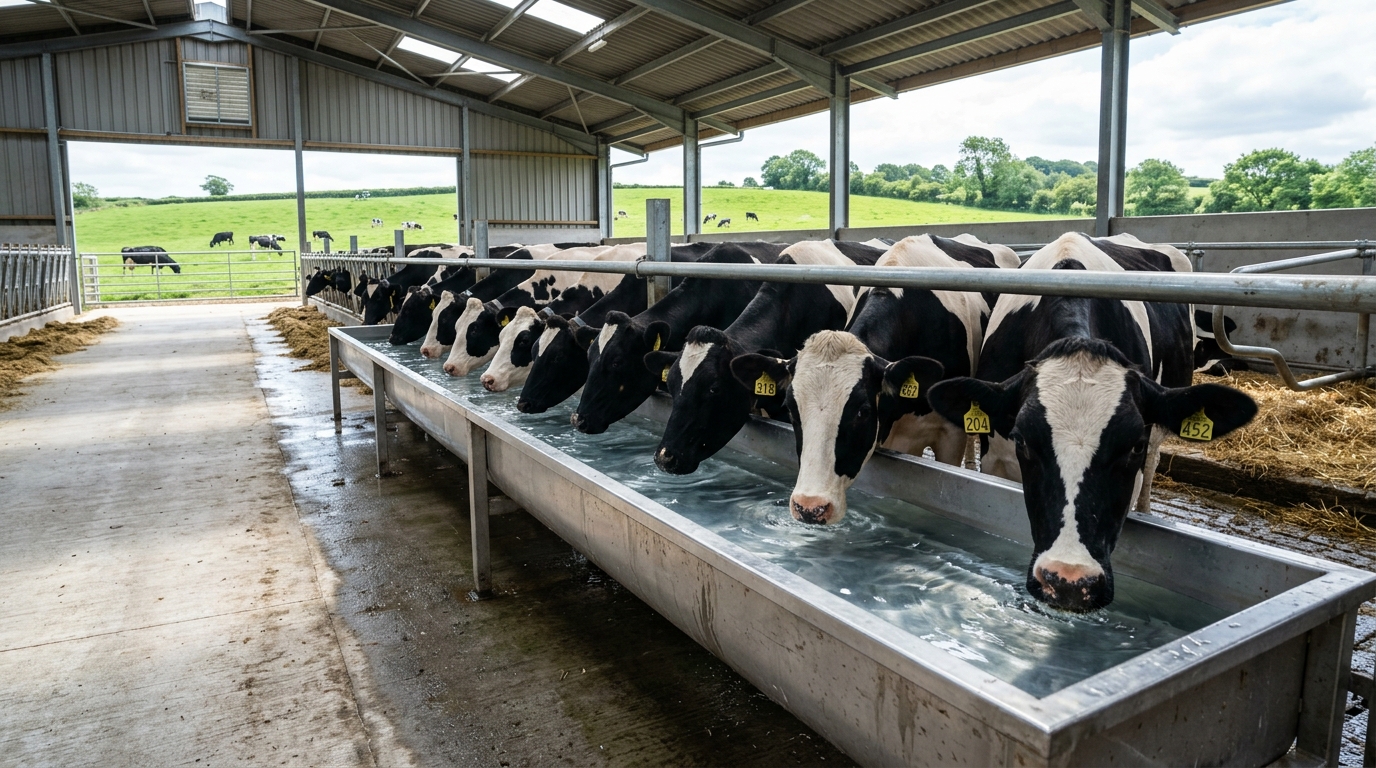
It's not just about how much water cows need — it's about whether they can access it fast enough. Cows drink at a rate of 3–5 gallons per minute, and a typical drinking bout lasts 5–10 minutes. If the trough empties during a drinking bout, cows don't return to finish — they simply walk away with less water than they needed.
Key trough access principles:
- Minimum depth: 8 inches (20 cm) for lactating cows, 6 inches (15 cm) for dry cows/heifers. Cows need to submerge their muzzle to drink efficiently.
- Minimum frontage: 3 inches (7.5 cm) of trough water surface per cow in the group. For 100 cows, that's 300 inches (25 feet) of trough length.
- Refill rate: The trough should refill fast enough that all cows can drink within 30–45 minutes. If cows are queuing or walking away, your flow rate is too low.
- Placement: Locate troughs near the feedbunk and in shaded areas. Cows drink more when water is convenient and cool.
Water Intake by Temperature — Reference Table
Use this table as a quick reference for estimating daily water requirements based on ambient temperature. Values are for lactating dairy cows at moderate milk yield (~70 lbs/day).
| Temperature | Lactating Cow | Dry Cow | Heifer | Heat Stress? |
|---|---|---|---|---|
| 50°F / 10°C | 27 gal / 102 L | 10 gal / 38 L | 7 gal / 26 L | No |
| 59°F / 15°C | 30 gal / 114 L | 12 gal / 45 L | 8 gal / 30 L | No |
| 68°F / 20°C | 35 gal / 132 L | 14 gal / 53 L | 10 gal / 38 L | No |
| 77°F / 25°C | 40 gal / 151 L | 16 gal / 61 L | 12 gal / 45 L | Mild |
| 86°F / 30°C | 48 gal / 182 L | 18 gal / 68 L | 14 gal / 53 L | Moderate |
| 95°F / 35°C | 55 gal / 208 L | 20 gal / 76 L | 16 gal / 61 L | Severe |
| 104°F / 40°C | 60+ gal / 227+ L | 22 gal / 83 L | 18 gal / 68 L | Fatal risk |
For high-producing Holsteins (80+ lbs milk/day), add 10–15% to the lactating cow values above. For heat stress conditions, add 15–25% depending on THI severity.
Check Heat Stress Risk
Calculate THI and estimate milk yield losses for your current temperature and humidity.
Signs of Water Deficiency in Dairy Cows
Water deficiency can reduce milk production, impair fertility, and increase health risks. Watch for these signs:
Reduced Milk Production
The first and most measurable sign. A cow that drops just 10% below her water requirement can lose 5 to 10 pounds of milk per day. The loss is often not immediately visible because cows compensate by drinking more at the next opportunity — but the production gap persists for 24 to 48 hours.
Dry Manure
Manure becomes firm, dark, and stacked rather than loose and patty-shaped. This is one of the easiest visual indicators. In severe cases, manure may appear as hard balls, indicating significant dehydration.
Dark Urine
Normal cow urine is pale yellow to clear. Dark, concentrated urine indicates the kidneys are conserving water — a clear sign of dehydration.
Increased Somatic Cell Count
Dehydration reduces the cow's ability to fight infection. Studies show water-restricted cows have higher somatic cell counts and increased risk of mastitis. Monitor SCC closely during periods when water access may be limited.
Reduced Feed Intake
Cows reduce dry matter intake when water is limited. Since feed and water intake are closely linked, drop in feed consumption often accompanies water restriction. This creates a negative cycle — less feed means less milk, which compounds the financial impact.
Heat Stress Exacerbation
Water-deficient cows cannot cool themselves effectively through panting and sweating. Heat stress becomes more severe and lasts longer when water intake is inadequate. This is critical during summer months when water requirements are already elevated.
How to Size Your Water Trough
Correct trough sizing ensures all cows can drink enough, even during peak demand periods.
The Basic Formula
Trough Size (gal) = (Cows × Daily Intake per Cow) ÷ Refills per Day
For example: 100 lactating cows × 50 gallons/day ÷ 6 refills = 833-gallon trough.
Trough Size Examples
| Herd Size | Daily Demand | Trough (6 refills) | Trough (continuous) | Min Frontage |
|---|---|---|---|---|
| 50 cows | 2,500 gal / 9,464 L | 417 gal / 1,578 L | 104 gal / 394 L | 12.5 ft / 3.8 m |
| 100 cows | 5,000 gal / 18,927 L | 833 gal / 3,153 L | 208 gal / 787 L | 25 ft / 7.6 m |
| 250 cows | 12,500 gal / 47,318 L | 2,083 gal / 7,886 L | 521 gal / 1,973 L | 62.5 ft / 19.1 m |
| 500 cows | 25,000 gal / 94,635 L | 4,167 gal / 15,772 L | 1,042 gal / 3,944 L | 125 ft / 38.1 m |
Based on 50 gallons per cow per day for lactating herd at moderate temperature.
Size Your Water Trough
Calculate daily water intake per cow and the recommended trough size for your herd.
Water System Best Practices
- Clean troughs weekly: Remove algae, slime, and debris. Bacterial growth reduces water quality and intake. Use a mild bleach solution (1 tbsp per gallon) and rinse thoroughly.
- Check flow rates monthly: Ensure automatic fill valves are operating correctly. A partially clogged valve can reduce flow rate below the minimum 3–5 gallons/minute needed for adequate trough refill.
- Position near shade and feed: Cows drink more when water is convenient. Locate troughs within 50 feet of the feedbunk and in shaded areas during summer.
- Protect from freezing: In cold climates, use frost-free waterers or tank heaters to prevent ice formation. Cows that have to break ice to drink will reduce intake significantly.
- Monitor water quality: Test water annually for bacterial contamination (coliform count), mineral content (especially iron, sulfur, and nitrates), and pH. Poor-tasting water reduces intake even if it's safe to drink.
- Multiple trough locations: In large herds, providing water at multiple locations reduces competition and ensures subordinate cows have access. At least 2 water points per group is recommended for herds over 100 cows.
Frequently Asked Questions
How much water does a dairy cow drink per day?
A lactating dairy cow drinks 30 to 50 gallons (115 to 190 liters) of water per day under normal conditions. During heat stress (THI above 72), intake can increase by 50% or more, reaching 60+ gallons. Water intake is driven primarily by milk yield — every pound of milk requires approximately 3.2 pounds of water to produce.
How much water does a cow drink in hot weather?
In hot weather (above 86°F / 30°C), a lactating dairy cow can drink 48 to 60+ gallons per day. For every degree above 68°F (20°C), water intake increases by approximately 1 to 1.5 gallons. During severe heat stress (THI above 80), water requirements can double compared to thermoneutral conditions.
What happens if a dairy cow doesn't drink enough water?
Water deficiency in dairy cows causes reduced dry matter intake, decreased milk production, constipation (dry manure), dark-colored urine, increased somatic cell count, and in severe cases, dehydration and metabolic disorders. A cow that drops just 10% below her water requirement can lose 5 to 10 pounds of milk per day.
How big should a water trough be for dairy cattle?
The minimum recommended trough size is 3 inches (7.5 cm) of trough water surface per cow in the group for troughs that refill continuously. For troughs that refill on a schedule, divide the total daily herd water demand by the number of refill cycles per day. Our calculator above automates this calculation.
How does water intake affect milk production?
Water is the most important nutrient for milk production — milk is approximately 87% water. Research shows that for every 1% decrease in water intake below requirement, milk yield drops by approximately 1 to 2 pounds per day. Cows that run out of water for even a few hours will show measurable milk loss for 24 to 48 hours afterward.
References
- Penn State Extension. (2025). "Water Requirements for Dairy Cattle." Penn State University Agricultural Sciences.
- National Research Council. (2001). "Nutrient Requirements of Dairy Cattle." 7th Rev. Ed. NRC, Washington DC.
- University of Wisconsin-Madison Extension. (2025). "Water Intake and Trough Management for Dairy Herds." UW-Madison Division of Extension.
- USDA Agricultural Research Service. (2025). "Water Intake and Requirements of Lactating Dairy Cows." ARS Dairy National Program.